UPDATE: Nooro Foot Massager is SELLING OUT faster than expected! Lock in your order NOW to get 50% OFF + FAST SHIPPING

For 6 years my legs would go numb halfway down my own street. Turns out it was never a leg problem.
After six years of numbness, burning, and legs that gave out on her own driveway — a 62-year-old retired English teacher from Sarasota writes about what four specialists missed and one question from her daughter revealed.

3,791 Ratings

By: Karen Sullivan

If your legs go numb halfway down your own street...
If your feet burn, or tingle, or feel like you're dragging cement blocks after 100 feet of walking...
If you've started planning your day around where you can sit down — and you can walk further leaning on a shopping cart than you can walk without one...
If your hip X-rays came back clean and your knee scans came back clean and everyone keeps telling you it's "just aging"...
I'm writing this for you. Because I was you.
Six years ago I could walk three miles on the beach every morning before breakfast.
By the time I turned 62, I couldn't make it from my front door to the mailbox at the end of my own driveway without stopping.
My legs would go numb from the knees down.
My feet would burn like I was walking on hot sand.
Some mornings my right leg would just give — not painfully, just go — like the signal from my brain didn't quite arrive.
Here is the strangest part.
My back didn't hurt.
Not really.
A little stiffness some mornings. But nothing I would have gone to a doctor about.
Every symptom I had was in my legs and my feet. So that was where every specialist looked.
I saw four of them across six years. Each one told me something different. Nothing held.
Then last October, my daughter Rachel — she's a nurse practitioner at a spine clinic in Tampa — came home for a weekend and asked me one question that changed everything.
The problem was never in my legs.
How My Legs Started To Fail Me

It began in 2018, not with pain, but with numbness.
I was walking my usual three-mile stretch on Siesta Key.
About halfway back, my right calf went numb. Not tingling.
Just... gone.
Like the leg had been turned off from the knee down.
I told my husband Tom about it over breakfast.
He said "you're probably just getting older, honey. Slow down a little."
Then it started happening more often. First once a week. Then every walk.
Then my feet started tingling. My left calf joined my right.
Then it wasn't after a mile — it was after half a mile, then a quarter, then before I reached the water.
By 2020 I had a symptom I couldn't ignore: my legs felt heavy.
Like I was dragging cement blocks tied to my ankles.
Standing in line at the grocery store became something I couldn't do.
Then I noticed something odd.
If I leaned forward on the shopping cart handle — really put my weight into it — I could push through another whole aisle.
If I sat down on a bench for two or three minutes, my legs came back completely.
Walking uphill on Siesta Drive was easier than walking back down.
I told my primary care doctor about it.
She nodded, made a note, and said it was "probably just some age-related changes" and to try to walk more, not less.
By 2022 my right leg was giving out on me.
Not falling — just going, for a second.
It happened three times on my own driveway one week.
That was when I finally started seeing specialists.
Four Specialists. Four Different Explanations. All Of Them Pointed At My Legs.

My primary care doctor sent me to an orthopedic surgeon first. That's where nearly everyone gets sent when the problem seems to be in the legs.
She ordered X-rays of both hips and both knees. Everything came back clean.
She said "your joints look good for your age, Karen. I don't see anything here that would explain what you're describing."
Then she said the sentence that stopped me cold: "You know, you're really a little too young to be having serious mobility issues like this."
I was 58 years old. Sitting in her office. Unable to walk to the mailbox.
And I was being told I was too young for anything to actually be wrong.
I drove home and did not tell Tom what she had said. I sat in the driveway for a while first.
Something inside me went quiet after that appointment. I stopped saying out loud how bad it was getting.
She sent me to a rheumatologist.
He tested me for every inflammatory arthritis he could think of. Rheumatoid. Psoriatic. Ankylosing spondylitis. Everything negative.
He offered me anti-inflammatories to try. They did nothing.
By 2023 I was seeing a pain management specialist someone at church had recommended.
He looked at my records and said the words I would hear from three more people over the next two years:
"It sounds like a pinched nerve. Probably sciatica. Let's treat it that way."
He was the first person to order an MRI of my lower back.
It came back showing what he called "some age-related narrowing at L4-L5, consistent with your years."
He didn't seem to think this was the cause. He said the imaging was "unremarkable for someone your age" and moved on to talking about injections.
Eventually, in year four, I ended up in front of a neurologist — the last stop, the way it usually goes.
He ran nerve conduction studies on both legs.
Everything came back "borderline."
He wasn't quite sure but suggested it might be early peripheral neuropathy and to come back in a year for repeat testing.
I never went back.
Because between the orthopedic surgeon telling me I was too young, the rheumatologist finding nothing, the pain management specialist calling my MRI unremarkable,
and the neurologist telling me my nerve studies were borderline — I had four different explanations and none of them added up to a plan.
What I did have was the pain management doctor's recommendation to start "treating it as a pinched nerve."
That's when the real parade began.
Everything I Tried Over 4 Years

What followed was four years of what I now call the parade.
Anti-inflammatories. Naproxen, then celecoxib. Each specialist prescribed something a little stronger. I took them faithfully. My legs kept going numb.
Two rounds of physical therapy. 12 weeks each. Two different therapists. Both gave me the same exercises — piriformis stretches, hip flexor releases, glute bridges, "core strengthening." My abdominals got firmer. My legs kept failing.
Three epidural cortisone injections. The first one gave me almost five months of real relief — I thought I had been saved. The second gave me eight weeks. The third barely gave me three. He wanted a fourth. I said no.
Gabapentin. Started at 300mg. Ended at max dose. Made me foggy. Made me gain 16 pounds. Made me forget the names of former students I had taught for 20 years. My legs still went numb.
A rigid back brace. Recommended after the neurologist's borderline results. Made my skin break out. Made my back weaker every month I wore it.
A TENS unit my son ordered off Amazon. I placed the pads on my calves, my thighs, my lower back. I felt a buzzing on my skin. Nothing deeper. It went in the drawer.
By early 2024 I finally got a second opinion from another orthopedic surgeon.
He looked at a repeat MRI and used the word I had been dreading:
"Karen, the narrowing at L4-L5 has progressed. If this continues, we should start talking about a laminectomy."
Surgery.
To carve bone away from what he was calling a genuinely compressed nerve — the same nerve my first MRI had shown four years earlier, back when it was "unremarkable for my age."
I left his office and sat in the parking lot for twenty minutes.
Four specialists. Six years. Over $14,000 out of pocket.
Two rounds of PT, three injections, one prescription that fogged my brain, one brace, one TENS unit.
And now surgery.
Everyone had eventually agreed my nerve was pinched.
Nobody could explain why it was pinched.
And nobody could explain why nothing they had done had reached whatever was pinching it.
The Weekend Rachel Came Home

Rachel is my youngest daughter. She's 38.
She's been a nurse practitioner for ten years — but the first seven were in family medicine in Miami.
It wasn't until 2023 that she moved to a spine specialty clinic in Tampa.
That's where she started seeing patients like me every day.
Something else you should know. I never told her how bad it had gotten. I have four kids.
I did not want them worrying about me. During phone calls I kept it light — I would ask about her husband, tell her about my garden.
I would always be sitting when she called so she couldn't hear it in my voice.
She came home for a weekend last October. Tom picked her up from the airport on Friday afternoon.
She watched me walk from the entryway to the kitchen. She watched me lean on the counter to talk to her.
She watched me sit down heavily, the way I now had to.
Then she asked me a question I had never been asked in six years.
"Mom. In all these appointments — has anyone ever tested whether your multifidus is firing?"
I didn't know what she meant. I had never heard the word.
In six years. Across four different specialists. Through nerve conduction studies, two MRIs, three rounds of imaging.
Nobody had mentioned the multifidus. Not once.
Rachel spent the next hour explaining it to me — first over coffee at the kitchen table, then on the back porch because I couldn't sit through it in a hard chair.
"She said one sentence that stayed with me longer than anything else.
'Mom, everything you feel in your legs is happening because a nerve in your lower back can't get any breathing room. And there's a specific reason it can't get any breathing room, and nobody has been looking at it.'"
What Rachel Told Me — In The Order She Told Me

She started with the simplest possible question.
"Where do you feel it, Mom?"
I told her. Calves, mostly. Feet sometimes. My thighs when I stood too long. My right leg gives out.
"Okay. So here's the part every doctor keeps missing. You feel it in your legs. But your legs aren't the problem."
She grabbed a napkin off the table and started drawing.
The first thing you need to understand: the nerves that go to your legs and feet don't start in your legs.
They start in your lower spine.
They exit your spine through small openings between the vertebrae in your lower back — L4, L5, and S1, mostly — and then they travel down into your buttocks, your thighs, your calves, your feet.
The second thing: when one of those nerves gets compressed as it exits the spine, the sensation doesn't show up where it's being squeezed.
It shows up where the nerve ends.
The nerve is being pinched in your lower back — but your body reports it in your calf, your foot, your toes.
That's why doctors kept using the phrase pinched nerve.
That was the first accurate piece anyone had given me.
And it changed something.
Because for the first time in six years, someone was telling me the sensation in my legs wasn't a signal about my legs.
It was a signal about my back — that had been trying to get my attention for years.
Then Rachel asked the next question:
"Why do you think that nerve is getting pinched in the first place, Mom?"
I said I didn't know. I assumed a disc, or arthritis, or "just getting older."
She said none of those were quite right.
The Muscle That Holds The Nerve's Breathing Room

Here's what she drew next.
Every vertebra in your lower back has a small opening on either side where a nerve exits and travels down toward your legs.
That opening has a name — the foramen — but that's not the part that matters.
What matters is that the size of that opening depends on how far apart the two vertebrae above and below it are being held.
Stack the vertebrae properly and the opening stays open. The nerve has breathing room.
It travels down to your leg without any interference.
Let those vertebrae collapse together — even a little — and the opening narrows.
The nerve gets pinched.
And the moment it gets pinched, your body starts sending signals to wherever that nerve ends up.
Your calf. Your foot. Your thigh.
So the real question isn't "why is the nerve pinched."
The real question is "what is supposed to be holding those vertebrae apart — and why has it stopped doing its job?"
The answer is a muscle. One muscle.
A muscle that runs the entire length of your lower spine, sitting about 3 centimeters beneath the skin of your lower back, wrapping around every vertebra like an internal brace.
It's called the multifidus.
And it is — without exaggeration — the single most important muscle in your entire lower spine.
When the multifidus is working, it holds each vertebra in place.
It absorbs approximately 60% of the compressive load from your upper body.
It keeps the foramen — the opening where your nerves exit — open.
Your legs work. Your feet work.
You can walk three miles on the beach at sunrise without thinking about it.
You don't feel it working. You don't think about it. It just works.
Until it doesn't.
Why My Multifidus Had Been Offline For Six Years
Rachel said the next part more slowly.
Because it was the piece that made everything click.
"Mom, when your spine first started experiencing any kind of stress — six or eight or ten years ago — your brain did something protective.
It cut the neural signal to the multifidus. It shut the muscle down. As a reflex."
When the spine detects pain, injury, or the slow micro-traumas of ordinary aging, the nervous system responds by cutting the signal to the deep stabilizing muscles.
It's the brain saying "Stop firing. You're making things worse."
And the muscle obeys.
Within 48 hours of the original trigger, the multifidus can lose up to 80% of its function.
It atrophies. It shrinks. It goes silent.
And here is the piece that stopped me cold at the kitchen table:
It does not come back on its own.
Not with rest.
Not with two rounds of physical therapy.
Not with any of the exercises the therapists gave me.
Not with yoga, stretching, pilates, walking, or any voluntary movement.
Because the muscle isn't weak.
It is locked.
You cannot strengthen a muscle your brain has switched off.
Researchers have a name for this. They call it Core Muscle Lockout.
And once I understood those two words, everything from the previous six years finally made sense.
My multifidus had been offline for years.
Without it firing, my vertebrae had been slowly collapsing on each other.
The opening where my sciatic nerve exits at L5-S1 had been closing, month by month, for six years.
That was the pinched nerve.
That was why my legs went numb. That was why my feet burned.
That was why I couldn't make it to the mailbox.
And that was why nothing I had tried had ever held.
Why Every Treatment Had Failed
Sitting on the back porch with Rachel, I finally understood.
Physical therapy couldn't reactivate the multifidus because you cannot voluntarily contract a muscle the nervous system has switched off. My therapists were strengthening my abdominals and glutes and hip flexors — every surface muscle around the foundation muscle that was actually needed.
The epidural injections only worked temporarily because they reduced inflammation around the pinched nerve for a few weeks. But nothing addressed the reason the foramen kept narrowing. Once the steroid wore off, the same vertebrae were still closing in on the same nerve.
The TENS unit did nothing because TENS reaches 5 to 8 millimeters into the skin. My multifidus sits 30 to 50 millimeters deep. A TENS unit literally could not reach it.
The brace made it worse because it outsourced the multifidus's job to an external strap — and every month my actual muscle got weaker.
The gabapentin muted the signal without addressing why the signal was being sent.
And the laminectomy the second orthopedic surgeon wanted to schedule?
Rachel's exact words:
"Mom, laminectomy carves bone off to make more room in the canal. That's it. Nothing about the operation addresses the muscle that let the space collapse in the first place.
Which is why so many patients have the pain come back within a year or two of surgery — the underlying muscle is still offline and everything keeps closing in."
I wasn't broken.
My body hadn't failed me.
I had a muscle that had been switched off for six years, and no one had ever tried to turn it back on.
The One Thing That Actually Reactivates The Multifidus
Rachel told me there was only one thing on earth that could wake up a multifidus that had been locked for years.
It wasn't more physical therapy.
It wasn't more injections.
It certainly wasn't surgery.
It was NMES.
Neuromuscular Electrical Stimulation.
Not TENS. She was very clear about this — the two are often confused and they are completely different technologies.
TENS sends weak pulses to the surface of the skin — 5 to 8 millimeters deep. It buzzes.
It masks pain by distracting the nerve signals at the skin level.
It has no effect on any muscle underneath.
NMES sends targeted electrical signals 30 to 50 millimeters deep — directly into the muscle tissue.
It bypasses the brain's "off" signal completely.
It doesn't ask the multifidus to fire. It makes it fire.
Contraction after contraction.
Forcing the muscle back online.
Rebuilding the neural pathway between brain and muscle that had been severed for years.
NMES has been used for 40 years in elite sports medicine, post-surgical rehabilitation, and in ICUs to prevent muscle atrophy.
It's how Olympic athletes recover from spinal injuries in weeks instead of months.
Until recently, you could only access clinical-grade NMES inside hospital rehabilitation departments and sports medicine clinics — $300 per session, referrals required.
Then Rachel told me about a device that had recently changed that.
The Device That Got Me Back On The Beach
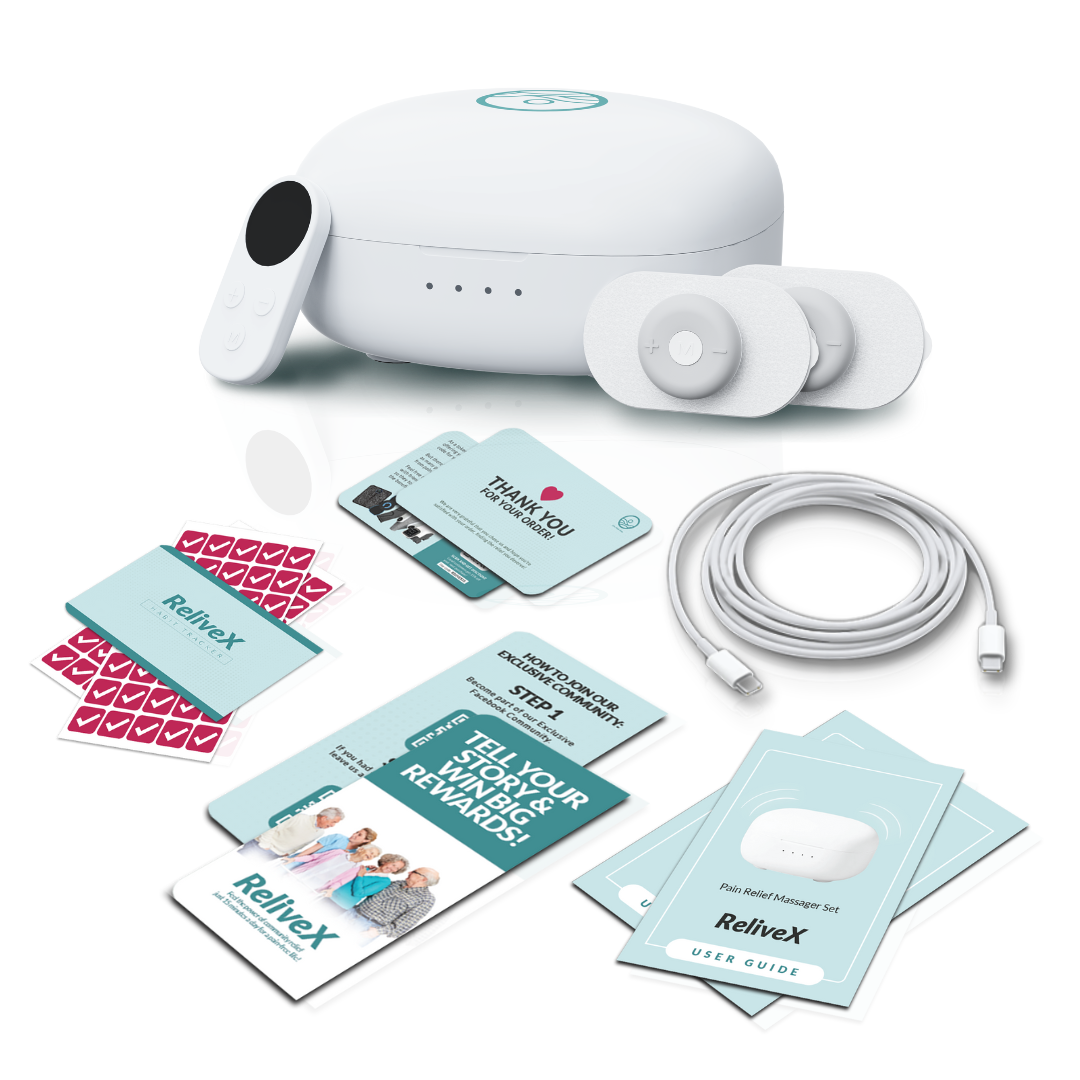
It's called the ReliveX Adaptive Correction System.
It's the first at-home NMES device specifically calibrated to reach the multifidus at 30 to 50 millimeters — the exact depth needed to break a Core Muscle Lockout.
But here's what makes it different from every other NMES device on the market.
It doesn't just stimulate the muscle.
It decompresses the spine AND rebuilds the muscle — at the same time.
Rachel walked me through the two phases:
Phase A: Decompression. The electrical pulses trigger gentle, rhythmic contractions that pull the vertebrae apart from the inside.
Space opens up between each level of the lower spine.
The pressure on the pinched nerve — the one that was making my legs go numb and my feet burn — lifts.
Most people feel this in the first two minutes as a distinct "opening" in the lower back.
Phase B: Re-Education. While Phase A is creating space, Phase B is forcing the multifidus to fire.
Contraction after contraction.
Over 30 days, the neural pathway between brain and muscle rebuilds. The brain "remembers" how to use the muscle.
It starts firing on its own — even when the device is off — holding my vertebrae apart, keeping the openings where my nerves exit clear, letting the signal to my legs and feet travel down uninterrupted.
15 minutes a day. That was the whole protocol.
Rachel sent me the link before she flew back to Tampa.
I ordered it that Sunday night.
Retail price: $99.95.
Less than one physical therapy session.
Less than one month of the gabapentin I no longer take.
What Happened Over The Next 90 Days
The device arrived seven days later.
I'll be honest — I opened the box with almost no hope.
I had been burned so many times that I had emotionally stopped believing anything would work.
I told Tom: "If this doesn't do anything, I'm scheduling the laminectomy in the spring."
I meant it.
Day 1: I placed the pads on either side of my lower spine. I started at a low intensity.
And I felt something I had not felt in six years — a deep pulse.
Not on the surface. Inside.
By minute 8 my lower back felt open. Something at L4-L5 had let go.
Week 4: I noticed I was walking through the grocery store without automatically reaching for the cart handle.
The tingling in my feet at night, which I had almost stopped noticing because it had been constant for so long, quietly stopped.
I walked to the mailbox and back — no stops. First time in over three years.
Week 8: I walked to the end of my street. Down and back. About half a mile round trip.
My legs did not go numb.
Week 10: I called the orthopedic surgeon's office and cancelled my follow-up.
Told them I was not going to be discussing the laminectomy anymore.
Week 12: I drove to the public beach access on Siesta Key at 5:30 in the morning.
I walked south, past the drum circle spot, out to where the beach starts to narrow.
Two miles. I made it back to the car and sat in the driver's seat and cried.
"It wasn't the pain being gone. It was the feeling that my legs belonged to me again. For six years my body had been reporting a problem in my legs. And the moment my back could hold itself up, my legs stopped reporting."

Charlotte Hudson

the shopping cart thing hit me hard
Reviewed in the United States on Januari 27, 2026
Verified Purchase
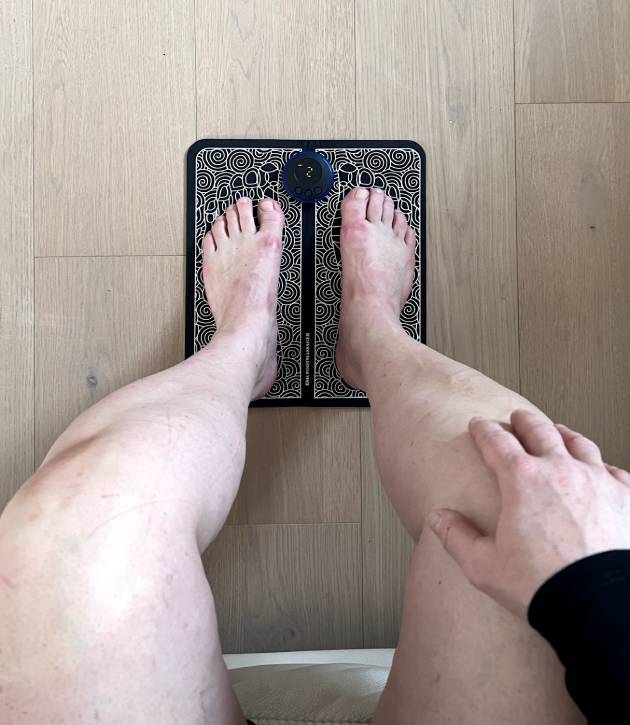
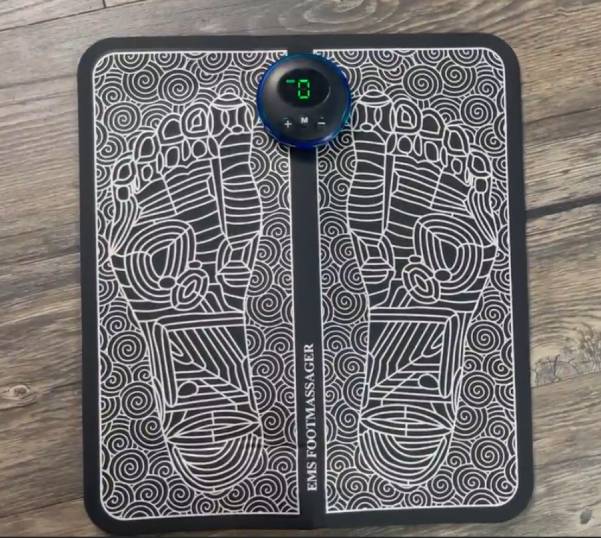
when karen wrote about leaning on the shopping cart i literally started crying at my kitchen table. i thought i was the only one. 3 different doctors and none of them ever asked me about that. 4 weeks with the device and yesterday i pushed my cart through the whole target without stopping. still processing this honestly

William Boxall
Walked to the end of my street this morning
Reviewed in the United States on April 12, 2026
Verified Purchase
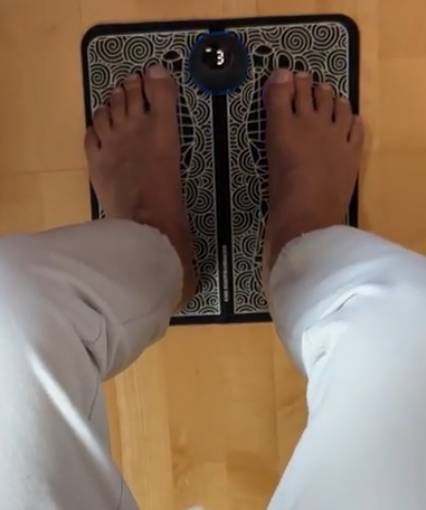
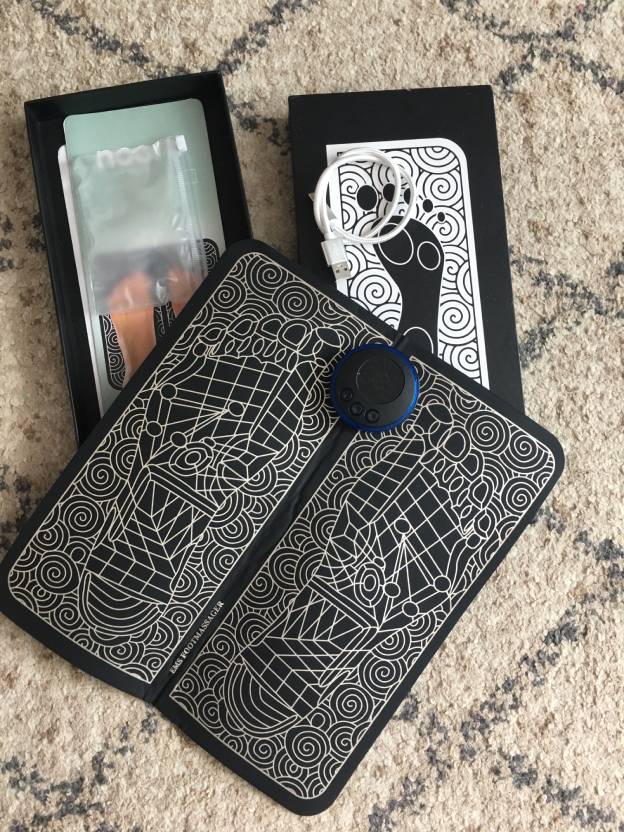
Retired firefighter. 66. Legs would go dead after about 200 feet for the last 4 years. Every doctor blamed something different — my knees, then my hips, then my "circulation." Two of them mentioned surgery. Ordered ReliveX after reading Karen's story. 7 weeks in and I walked to the mailbox at the end of my block this morning. Down and back. First time since 2021.
53 people found this helpful
76 people found this helpful

Susan B.
Told me I was too young. I'm 59.
Reviewed in the United States on April 21, 2026
Verified Purchase
Both feet going numb after walking half a block for 5 years now. My orthopedic said I was "too young to have serious back problems" and sent me home with anti-inflammatories that did nothing. Read Karen's article and cried through most of it. 6 weeks with ReliveX and I've got feeling back in both feet for the first time since 2020. My husband keeps asking why I'm smiling so much.
AS SEEN ON

Where I Am Now
I'm writing this 10 months after that first session.
By June of 2025 I was back to three-mile morning walks on Siesta Key — sunrise on the water, coffee waiting at home.
Tom sometimes walks the first mile with me.
I use ReliveX for 15 minutes on Monday, Wednesday, and Friday now.
That's my maintenance routine.
The rest of the time, my multifidus holds my lower spine in alignment.
The signal to my legs travels down uninterrupted. Like it did before 2018.
I never scheduled the laminectomy.
What I Want You To Know
If you are sitting where I was — legs that fail you on your own driveway, feet that go numb or burn, a shrinking world where you plan your day around where you can sit down —
I'm writing this because I wish someone had put this letter in my hand in 2018.
You have not failed. Your body has not failed you.
The sensation in your legs is not the problem. It is a signal.
The problem is in your lower back — where a nerve has been getting pinched for years by vertebrae that have been slowly closing in on it.
And the reason those vertebrae have been closing in is a muscle that has been switched off, quietly, for probably longer than your symptoms have been showing up.
Every treatment you have tried has aimed at the wrong place.
Not because you were wrong to try it.
Because nobody explained where the actual problem was.
You are not broken. You are locked. And there is a difference.
ReliveX Adaptive Correction System
The at-home NMES device I use every day.
Uses NMES (not TENS) — reaches 30-50mm deep to the multifidus
Dual-Action — Phase A Decompression + Phase B Re-Education
15-minute auto-shutoff — the exact window for muscle reactivation
Wireless, portable, easy to use
FDA-cleared and CE-certified
Designed to relieve pressure on nerves exiting the lower spine
Trusted by 140,000+ patients with chronic back and leg symptoms
90-Day Money-Back Guarantee
50% off today — limited stock
Today it's available at 50% off — $99.95.
Less than ONE physical therapy session.
Less than one month of the gabapentin I no longer take.
Less than one specialist co-pay.
The 90-Day Guarantee

Use it for 90 days. 15 minutes a day.
If your legs don't start feeling like your legs again — if the numbness doesn't quiet, if the burning doesn't fade, if your walking range doesn't come back — send it back.
Full refund. No forms. Just email support.
You have 90 days to know if this is the thing that finally works. That's more than enough time. I knew by day 14.
One Last Thing
If this letter has reached you, I'd ask you one favor.
Don't put it off.
I spent six years chasing a problem down my legs.
Six years going to specialists who each pointed at my legs.
Six years failing to reach a muscle nobody was looking at.
Every day you wait is another day your multifidus stays locked.
Another day the vertebrae in your lower back close in a little more on the nerves that are supposed to be traveling down to your legs and feet.
You have today.
That's enough.
With hope,
Karen Sullivan
Retired English Teacher, Sarasota, Florida
Back to three-mile sunrise walks on Siesta Key since June 2025

UPDATE: As of - The demand for ReliveX has increased dramatically and inventory has been flying off the shelves. Order your own for 50% OFF + FAST SHIPPING before it's too late.
Lock in your order while you can to get 50% OFF + FAST SHIPPING
NOTE: This deal is NOT available on Amazon or eBay.

90 Day Money Back Guarantee

Guaranteed Safe and Secure Checkout

No-Hassle Returns

Fast Shipping

Customer Reviews

4.8 out of 5
3,791 customer ratings
5 Star

90%
4 Star

7%
3 Star

2%
2 Star

0%
1 Star

1%
By Feature
Price
5.0
Effectiveness
5.0
Comfort
5.0
Quality
4.8
Comments
Add a comment ...

Wilma Devon
Can anybody vouch for this?
Like · Reply ·
4 · 39 min

Mary Vernon
This little thing is fantastic. My lower back aches constantly. After a long day, 15 minutes with this and the pain is gone. I've got stenosis and a herniated disc on top of that — nothing has helped like this does. Genuinely surprised how powerful it is.
Like · Reply ·
7 · 16 min

Doris Skylar
Legs going numb after 100 feet of walking for 5 years. Three specialists, two rounds of PT, one epidural that lasted 6 weeks. Nobody ever explained why the nerve was actually being pinched. Karen's daughter's explanation was the first time it made sense. 8 weeks with ReliveX and I walked through Costco last Saturday without a break. First time in three years.
Like · Reply ·
4 · 51 min

Skyler Greig
How long does shipping take??
Like · Reply ·
1 · 1 h

Marie Campbell
Hey Skyler, got mine after 4 days.
Like · Reply ·
2 · 24 min

Leonard Boyd
Had "sciatica" for 4 years!! Nobody could ever explain WHAT was actually pinching the nerve. Read this whole article twice. 6 weeks in now and the numbness in my left foot that had been constant for two years is gone. still hard to believe honestly

Like · Reply ·
6 · 1 h

Emma Emerson
Three epidurals in eighteen months. First one worked beautifully. Last one lasted maybe two weeks. My doctor started talking about fusion and I panicked. A friend sent me this article and honestly I rolled my eyes — I'd tried every gadget out there. But the explanation about the multifidus finally made sense of why nothing ever held. Six weeks in and I've cancelled my surgical consultation. I'm not pain-free but I feel stable for the first time in years.
Like · Reply ·
2 · 2 h

Lois Clive
Wow, this is crazy, have ordered one now!
Like · Reply ·
3 · 1 h

Alfred Johnson
Did you buy one, how long does it take to get it
Like · Reply ·
2 · 2 h

Edith Ashton
For me 4 business days.
Like · Reply ·
5 · 2 h

Debra Peyton
Retired 3 years ago. Started getting the burning in my feet and calves within a year. Told it was a pinched nerve, offered gabapentin, offered surgery eventually. Read Karen's article. 9 weeks with ReliveX and I walked my dog around the whole neighborhood yesterday morning. My wife has been quietly watching me walk without saying anything for weeks.
Like · Reply ·
1 · 3 h

Paula Remington
Wow looks amazing, does anyone actually have one and has it been tested?
Like · Reply ·
1 · 3 h

Sarah Dudley
Yes, I purchased this device for my mom who's been suffering from spinal stenosis.
Like · Reply ·
3 · 2 h

Agnes Graeme
I just ordered mine! Cannot wait for it.
Like · Reply ·
4 · 3 h

Barbara Bradly
I want one so bad, I'm gonna buy it this weekend when my paycheck hits lol!!
Like · Reply ·
8 · 3 h

Ethel Dean
Does anyone know how long the shipping takes? Want to buy one for my friend.
Like · Reply ·
1 · 4 h

Clara Milton
Hey Ethel, mine arrived after 5 days
Like · Reply ·
2 · 2 h

Emma Shelby
Your friend will be happy! Perfect gift
Like · Reply ·
2 · 1 h

Bridget Prescott
3 doctors, all said sciatica. Cortisone shots did nothing after the first one. This is the first thing i've read that actually explained why the nerve gets pinched in the first place. 5 weeks in and i walked around the block yesterday!! havent done that in over 2 years
Like · Reply ·
3 · 4 h
Clara Milton
I absolutely love my ReliveX, had to get one for my daughter today since she wont stop using mine!
Like · Reply ·
2 · 5 h

Kate Orson
OMG I know, I was so happy that they had some left today. Had to get one immediately before they run out of stock again like last time
Like · Reply ·
5 · 2 h

Isabella Mayson
This product is amazing! For anyone who has ever used an older model TENS device: you end up completely tangled in the wires, and if you need to use it at work to reduce flare-ups, it’s impossible when you have a job that requires a lot of movement. This product frees you from all that and allows you to use it safely. Thanks to whoever created this product.

Like · Reply ·
3 · 5 h
MEDICAL & HEALTH DISCLAIMER: The information and other content provided in this page, or in any linked materials, are not intended and should not be construed as medical advice, nor is the information a substitute for professional medical expertise or treatment.
If you or any other person has a medical concern, you should consult with your health care provider or seek other professional medical treatment. Never disregard professional medical advice or delay in seeking it because of something that have read on this page or in any linked materials. If you think you may have a medical emergency, call your doctor or emergency services immediately.