UPDATE: Nooro Foot Massager is SELLING OUT faster than expected! Lock in your order NOW to get 50% OFF + FAST SHIPPING

My fusion was textbook perfect. 22 months later I'm in more pain than before. My husband finally figured out why.
After L4-L5 fusion, two rods, four screws, and a second surgeon now pushing another fusion — a 65-year-old retired legal secretary writes what she wishes someone had told her before the surgery.

3,791 Ratings

By: Karen Sullivan

If your surgeon showed you the post-op X-ray and told you your fusion was "textbook perfect"...
If your hardware looks solid on every scan and every follow-up appointment ends with someone saying..
"the fusion is holding beautifully"...
If you did the six months of physical therapy afterward.
If you did the injections when the pain came back.
If you took the gabapentin when someone finally admitted the injections weren't holding either...
If someone has already started using the word "revision," or "adjacent segment," or "let's take a look at the level above"...
I'm writing this for you.
Because I was you.
I had an L4-L5 fusion in October 2023.
Two rods. Four screws.
My surgeon — a very good one, at a very good hospital in Cleveland — told me at my six-week follow-up that the surgery had gone exactly as planned.
He was telling me the truth. The imaging looked beautiful. The bones were fusing. The hardware was where it belonged.
22 months later I am in more pain than the day I signed the consent form.
My back aches in a way it never did before the operation.
My right leg burns from the knee down.
I walk stooped forward, like the letter C, because standing upright makes it worse.
I cannot stand at my own kitchen counter to make coffee.
I cannot walk from my front door to my mailbox without stopping.
About a year ago a second orthopedic surgeon looked at my most recent MRI and told me the level above my fusion — L3-L4 — was starting to deteriorate.
He recommended another fusion.
I sat in the parking lot afterward and cried for forty minutes.
Then I went home and told my husband Frank I would not do it.
And Frank — who is a retired mechanical engineer, and who had watched me get worse every month for almost two years — quietly started reading.
What he found over the next four months is what I am going to tell you.
How I Ended Up On The Operating Table
My back had been bothering me for about five years before the fusion.
Nothing dramatic at first — the kind of ache anyone who spent 40 years at a legal secretary's desk knows well.
Then in 2021 I started getting a sharper pain that radiated into my right buttock and down my thigh.
By 2022 I couldn't sit through a movie.
By early 2023 I couldn't drive to visit my sister in Cincinnati without stopping twice.
I did what people do. I saw my primary care doctor.
Then a pain management specialist.
I had two rounds of physical therapy.
Three cortisone injections. Gabapentin. A rigid brace.
Nothing held for long.
By the summer of 2023 the pain was interfering with sleep, with work, with walking my dog Millie on our own street.
My pain management doctor referred me to an orthopedic spine surgeon.
He was calm, kind, direct. He showed me my imaging on a large monitor.
He explained what he could do.
He told me most of his fusion patients did well.
He said if I did the rehab afterward, I had every reason to expect to be back to normal within six to nine months.
I trusted him. I signed the consent forms. I had the surgery in October.
Everything about the operation went exactly as promised.
I went home three days later.
I did the six months of physical therapy. I did the walking program.
I followed every instruction on every piece of paper the hospital sent home with me.
And still — 22 months later — here I am.
The First Year After The Surgery

For the first six weeks, I felt hopeful.
The immediate post-op pain was less than the pain I had walked in with.
I thought I had made the right decision.
By month three, the old pain was creeping back.
By month six, it was worse.
By month nine, I was back in my surgeon's office.
I brought my pain diary.
I brought a list of everything I couldn't do anymore that I had been able to do before the surgery. I asked him if something was wrong.
He looked at the imaging.
He said the fusion was solid.
He said the hardware was where it belonged.
He said "Beverly, sometimes recovery just takes longer than we expect. Give it another six months."
Six months. I gave him another six months.
Nothing changed.
By month fifteen I was seeing a pain management specialist twice a month.
I had another two rounds of epidural injections. He put me back on gabapentin.
He suggested a spinal cord stimulator — an implanted device that would send signals to override my pain signals.
I asked him why my back was worse now than before the surgery that was supposed to fix it.
He shrugged. Literally shrugged.
He said "Sometimes the body reacts unpredictably. Some people just don't respond to fusion the way we hope."
At month twenty I got a second opinion from another orthopedic surgeon in Cincinnati.
He looked at my imaging for less than ten minutes. He said the original fusion looked fine.
But the level above — L3-L4 — was showing degeneration.
He called it "adjacent segment disease" and said it was a known complication of lumbar fusion.
Then he recommended another surgery.
Another fusion. L3-L4 this time.
He said if we didn't address it now, L2-L3 would probably start to go too within a few years.
"I sat in his parking lot and did the math out loud in the car. Another surgery.
Another six weeks in a brace. Another six months of physical therapy.
Another $8,000 in copays and deductibles.
Another chance that it wouldn't work — or would make it worse, like the first one had."
I drove home and told Frank I was done.
I would rather live with the pain than get on that operating table again.
When Frank Started Researching

Frank is 68.
He spent 41 years designing hydraulic systems for a company that made industrial equipment for the mining industry.
He is not a doctor. He does not pretend to be one.
But his younger brother David is an orthopedic surgeon in Cleveland — not a spine specialist, but someone Frank could call to help him understand the papers he was reading.
And Frank spent 41 years looking at systems that failed and asking one question: "What did we miss?"
The morning after I told him I was cancelling the second surgery, he sat down at the kitchen table with his laptop and started reading.
Peer-reviewed papers. Orthopedic journals. Post-surgical outcome studies.
When he hit terminology he did not understand, he called David.
He read for four months.
Evenings, weekends, most of a fishing trip in April where he barely picked up a rod.
He filled two legal pads with notes.
One Sunday afternoon he came out to the back porch where I was reading and sat down across from me. He put a printout on the table between us.
He said: "Bev. I think I know why the surgery didn't hold. And I don't think a second surgery is going to hold either. There's something the surgeons don't rehab afterward, and I don't think most of them even test for it."
What Frank Found

He walked me through it slowly. Because he wanted to make sure I understood.
There is a muscle that runs the entire length of your lower spine.
It sits about 3 centimeters beneath the skin of your lower back, wrapping around every vertebra like an internal brace.
It is called the multifidus.
When it is working, it holds every vertebra in alignment.
It absorbs approximately 60% of the compressive load from your upper body.
It keeps the spinal canal open.
It keeps the openings where your nerves exit from getting narrower.
You don't feel it working. You don't think about it. It just works.
Here is what Frank found in the surgical research.
To reach the spine from the back — which is how nearly every lumbar fusion, laminectomy, and discectomy is performed — the surgeon has to cut through or retract the multifidus to get to the vertebrae underneath.
The nerves that control the multifidus — the medial branch nerves — run right through the surgical field.
They get damaged during the operation.
Not because the surgeon did anything wrong.
Because they are physically in the way of everything the surgeon has to do.
When those nerves get damaged, the muscle stops receiving a signal from the brain.
It goes silent.
Within weeks it starts to shrink.
Within months it fills with fatty tissue on imaging.
This is documented in dozens of MRI studies of post-surgical spine patients.
The muscle that was supposed to hold my spine in alignment — the muscle that would have absorbed the load that is now grinding down the level above my fusion — was disabled by the operation itself.
This is why my fusion is "solid" but I am in more pain than before it.
The hardware is doing its job.
The bones fused. But the muscle that would have supported the rest of my spine went silent the day I was on the table.
And nobody in my post-surgical rehab was reactivating it.
Because there is no standard test for it.
And because most surgeons and physical therapists are still teaching patients to strengthen the surface muscles — the abdominals, the glutes — that surround a muscle they cannot even reach.
Frank looked at me across the porch table.
He said the sentence I have not stopped thinking about since.
"Bev. The next surgery isn't going to hold either. And it isn't going to hold for the exact same reason the first one didn't. They're going to cut through the same muscle again to reach the next level. And the level after that is going to start going for the same reason."
He was right.
Every post-surgical patient I have talked to since — women in my church, my old friend Judith from the firm, three people on the online forum I found the week after — they had all been told the same thing.
Fusion looks solid, hardware is where it belongs, "your body just isn't responding the way we hoped."
All of us had the same missing piece. None of us knew to ask about it.
The One Thing That Reactivates The Multifidus

Frank told me there was one intervention documented in the research that could wake up a multifidus that had gone silent after surgery.
Not physical therapy. You cannot voluntarily contract a muscle whose nerve signal has been damaged.
Not injections. Nothing in the standard post-surgical protocol reaches deep enough.
Certainly not another surgery.
It was NMES. Neuromuscular Electrical Stimulation.
Not TENS. Frank was insistent on this — we had a TENS unit in a drawer from before my surgery and I had tried it after with no effect.
TENS sends weak pulses to the surface of the skin, 5 to 8 millimeters deep.
It buzzes. It masks pain temporarily. It has no effect on muscle tissue underneath.
NMES sends targeted electrical signals 30 to 50 millimeters deep — directly into the muscle tissue.
It bypasses the damaged nerve pathway entirely.
It doesn't ask the multifidus to fire. It makes it fire.
Contraction after contraction. Forcing the muscle back online.
Rebuilding the neural pathway between brain and muscle over time.
NMES has been used for 40 years in elite sports medicine and post-surgical rehabilitation.
It is how professional athletes recover from spinal injuries.
Until recently you could only access clinical-grade NMES inside hospital rehabilitation departments at $300 per session with referrals and waiting lists.
Frank found a device that had changed that.
The Device Frank Ordered That Weekend
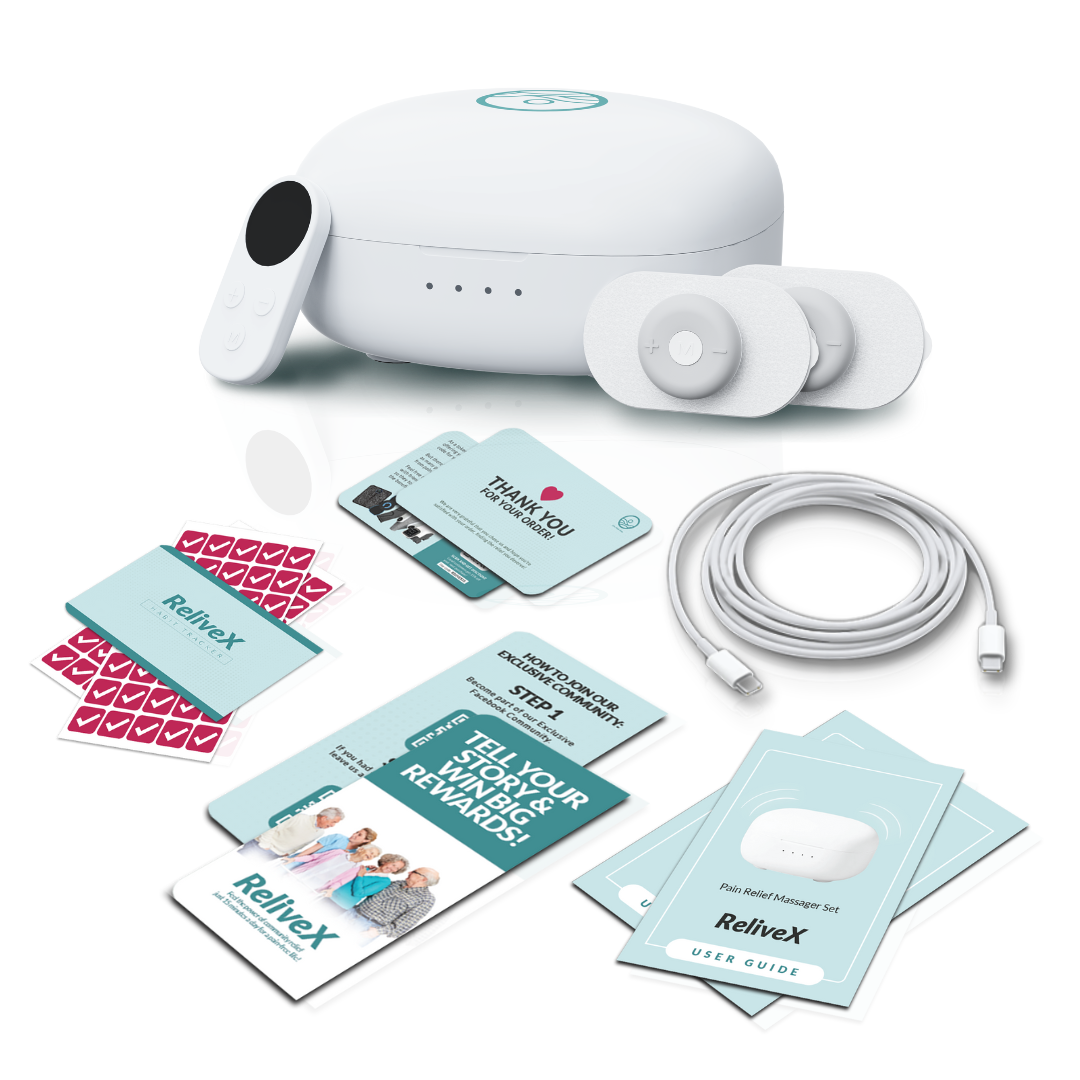
It's called the ReliveX Adaptive Correction System.
It's the first at-home NMES device specifically calibrated to reach the multifidus at 30 to 50 millimeters — the exact depth needed to break through a post-surgical shutdown.
But here's what makes it different from every other NMES device Frank looked at.
It does two things at once.
Phase A: Decompression. The electrical pulses trigger gentle rhythmic contractions that pull the vertebrae apart from the inside.
In a post-surgical patient this creates space between the fused level and the levels above and below — where the load is now falling.
Pressure lifts off the discs. The nerves get breathing room.
Most people feel this in the first two minutes as a distinct "opening" in the lower back.
Phase B: Re-Education. While Phase A is creating space,
Phase B is forcing the multifidus to fire. Contraction after contraction.
Over 30 days, the neural pathway that was disrupted during the surgery starts to rebuild.
The muscle begins holding my vertebrae in alignment again — including the ones above and below the fusion — absorbing the load that had been grinding down L3-L4.
15 minutes a day. That was the whole protocol.
Frank showed me the research. Frank showed me the reviews. Frank ordered it that
Sunday night. Retail price: $99.95.
Less than one physical therapy session.
Less than one month of the gabapentin I no longer take.
Less than the copay for the second surgery I had just cancelled.
What Happened Over The Next 90 Days
The device arrived seven days later.
I opened the box on the kitchen counter with almost no hope.
I had been burned so many times.
By the surgery. By the injections. By the PT protocols.
By every specialist who had told me to "just give it more time."
I told Frank: "If this doesn't do anything, I'm just going to live with it." I meant it.
Day 1: I placed the pads on either side of my lower spine, above and below the fusion. I started at a low intensity.
And I felt something I had not felt since before the operation — a deep pulse.
Not on the surface. Inside.
By minute 10 my lower back felt open in a way it had not felt in almost two years.
Week 2: The morning stiffness that had defined my life since the surgery started to ease.
I could stand at the counter for two minutes without shifting. Then five.
The burning in my right leg was quieter at night.
Week 4: I walked to the mailbox and back without stopping. First time in almost two years.
Week 6: I sat through Sunday service at church without shifting for a full hour. First time in over two years.
My friend Judith noticed and squeezed my hand at the coffee hour afterward.
Week 8: I walked Millie around the block. Slowly. Frank walked with me.
When we got back I sat on the porch and cried for a while, because I had almost forgotten what it felt like to walk with my dog.
Week 12: I called the surgeon in Cincinnati and cancelled the follow-up he had scheduled to discuss the L3-L4 fusion. I told his nurse I would not be coming back.
"It was not the pain going away that got me. It was the feeling that my spine had a muscle again.
For 22 months I had felt like I was being held together by the rods and screws alone.
And then, for the first time since the operation, something inside me was pulling its own weight."
Where I Am Now
I am writing this 8 months after that first session.
I stand at my kitchen counter. I walk Millie every morning.
I sat through my niece's wedding in June — a full two-hour ceremony and a three-hour reception — without needing to lie down.
Frank and I drove to visit my sister in Cincinnati in July and I did half the driving both ways.
My fusion is still there. The rods and screws are still where the surgeon put them.
But the muscle that would have supported the rest of my spine is now doing its job — for the first time since October 2023.
I use ReliveX for 15 minutes three times a week now.
That is my maintenance routine.
The rest of the time my multifidus holds the levels above and below my fusion where they belong.
I never scheduled the second surgery.
What I Want You To Know
If you are sitting where I was — fusion behind you, pain still ahead of you, someone starting to mention the level above or the second surgery you swore you would never have —
I am writing this because I wish someone had put this letter in my hand before I sat in that surgeon's parking lot last spring and did the math out loud.
You are not the exception.
You are not the patient who "just didn't respond."
Your body did not fail you. Your surgeon did not do anything wrong.
The operation reached your spine through a muscle. The muscle went silent.
Nobody put it back online.
And every treatment you have tried since — the PT, the injections, the medications, the brace, the stimulator someone offered — has aimed at the surface of a problem that lives underneath.
Another surgery will not solve it.
Because another surgery will go through the same muscle.
And the level after that will start to go for the same reason.
You do not need more hardware. You need the muscle back.
ReliveX Adaptive Correction System
The at-home NMES device I use every day.
✅ Uses NMES (not TENS) — reaches 30-50mm deep to the multifidus surface treatments couldn't touch
✅ Safe to use with rods, screws, plates, cages, and bone graft material — pads sit on the skin above the muscle, no interference with any titanium hardware
✅ Compatible with spinal cord stimulator (turn SCS off during your 15-minute session, back on after)
✅ Cleared for use after standard 6-week post-surgical follow-up — once your surgeon has cleared you for normal activity
✅ Dual-Action — Phase A decompression + Phase B multifidus re-education, in the same 15-minute session
✅ Wireless, portable, quiet — use it in your recliner while you read
✅ FDA-cleared and CE-certified
✅ Trusted by 140,000+ patients — thousands of them post-fusion, post-laminectomy, or post-discectomy
✅ 90-Day Money-Back Guarantee — full refund, no forms
Today it's available at 50% off — $99.95.
Less than one physical therapy session.
Less than one month of the gabapentin I no longer take.
Less than one specialist copay.
Less than $100 to try what nobody had explained to me before I signed the consent form.

Charlotte Hudson

L4-L5-S1 fusion 2021. First relief in 4 years.
Reviewed in the United States on Januari 27, 2026
Verified Purchase
Two-level fusion 2021, 4 rods, 8 screws. Every follow-up they told me the hardware looks textbook. I've been walking stooped over like the letter C for 3 years now. Read Beverly's article and it was like she was writing about me. 10 weeks in and I'm standing straight enough to reach my top kitchen cabinet without a stool for the first time since the operation. My wife caught me doing it and started crying.

William Boxall
cancelled the revision they wanted to do
Reviewed in the United States on April 12, 2026
Verified Purchase
laminectomy L4-L5 in 2020. six years of pain since. neurosurgeon has been pushing a fusion revision for over a year now. i almost signed the papers last month. then a friend from my church sent me beverly's article. ordered ReliveX same night. 7 weeks in and i walked my dog around the whole block twice yesterday. called and cancelled the surgery consult this morning!!

Susan B.
They already want to do the level above.
Reviewed in the United States on April 21, 2026
Verified Purchase
L5-S1 fusion February 2024. Right leg has been burning since I woke up from the surgery. Second surgeon told me last spring L4-L5 is starting to go and we should "get ahead of it" with another fusion. My son found this article and printed it out for me. 8 weeks with ReliveX and the burning in my right leg is quieter than any time since the operation. Not scheduling that second fusion. Ever.
AS SEEN ON

The 90-Day Guarantee
Use it for 90 days. 15 minutes a day.
If your back doesn't start feeling supported again — if the pain doesn't quiet, if the stooped-forward posture doesn't come back to normal, if your walking range doesn't return — send it back.
Full refund. No forms. Just email support.
90 days is more than enough time to know. I knew by week 4.
One Last Thing
If someone is trying to schedule you for a second surgery — a revision, an adjacent segment fusion, a spinal cord stimulator — don't sign anything until you have tried this.
I almost went back on that table.
Frank stopped me.
And what he found in four months of reading has given me my life back in eight months of using it.
You do not have to keep adding hardware to a problem that isn't a hardware problem.
You have today. That is enough.
With hope,
Beverly Hartwell
Retired Legal Secretary, Columbus, Ohio
Standing at her own kitchen counter again since March 2025

UPDATE: As of - The demand for ReliveX has increased dramatically and inventory has been flying off the shelves. Order your own for 50% OFF + FAST SHIPPING before it's too late.
Lock in your order while you can to get 50% OFF + FAST SHIPPING
NOTE: This deal is NOT available on Amazon or eBay.

90 Day Money Back Guarantee

Guaranteed Safe and Secure Checkout

No-Hassle Returns

Fast Shipping

Customer Reviews

4.8 out of 5
3,791 customer ratings
5 Star

90%
4 Star

7%
3 Star

2%
2 Star

0%
1 Star

1%
By Feature
Price
5.0
Effectiveness
5.0
Comfort
5.0
Quality
4.8
Comments
Add a comment ...

Wilma Devon
Can anybody vouch for this?
Like · Reply ·
4 · 39 min

Mary Vernon
This little thing is fantastic. My lower back aches constantly. After a long day, 15 minutes with this and the pain is gone. I've got stenosis and a herniated disc on top of that — nothing has helped like this does. Genuinely surprised how powerful it is.
Like · Reply ·
7 · 16 min

Doris Skylar
Had my fusion in 2022. Every follow-up they said the hardware looks great. I've been in agony 24/7 for 3 years. Read this article Sunday, ordered it Monday. 9 weeks in and my back is quieter than any time since the operation. I don't have the words for what this means.
Like · Reply ·
4 · 51 min

Skyler Greig
How long does shipping take??
Like · Reply ·
1 · 1 h

Marie Campbell
Hey Skyler, got mine after 4 days.
Like · Reply ·
2 · 24 min

Leonard Boyd
L4-L5 fusion in 2021. surgeon has been pushing revision at L3-L4 for 8 months now. read Beverly's article twice. Ordered ReliveX. Called and cancelled the surgery consult yesterday!! 6 weeks in and something is holding in my back that hasn't held in years.

Like · Reply ·
6 · 1 h

Emma Emerson
Two-level fusion L4-S1 in 2020. Been on 4 medications since. Both a spine stimulator implant and a second fusion have been suggested to me in the last year. What Beverly's husband found is the first thing that has actually explained why nothing has held. 8 weeks in and I'm walking my grandson to school 3 days a week now.
Like · Reply ·
2 · 2 h

Lois Clive
Wow, this is crazy, have ordered one now!
Like · Reply ·
3 · 1 h

Alfred Johnson
Did you buy one, how long does it take to get it
Like · Reply ·
2 · 2 h

Edith Ashton
For me 4 business days.
Like · Reply ·
5 · 2 h

Debra Peyton
Had a laminectomy L4-L5 in 2019. Six years of pain since. Every specialist said the surgery looked fine and my body was just "responding poorly." First article I've read that explained WHY. 5 weeks with ReliveX and the burning down my left leg is quieter than it has been since before the operation.
Like · Reply ·
1 · 3 h

Paula Remington
Wow looks amazing, does anyone actually have one and has it been tested?
Like · Reply ·
1 · 3 h

Sarah Dudley
Yes, I purchased this device for my mom who's been suffering from spinal stenosis.
Like · Reply ·
3 · 2 h

Agnes Graeme
I just ordered mine! Cannot wait for it.
Like · Reply ·
4 · 3 h

Barbara Bradly
I want one so bad, I'm gonna buy it this weekend when my paycheck hits lol!!
Like · Reply ·
8 · 3 h

Ethel Dean
Does anyone know how long the shipping takes? Want to buy one for my friend.
Like · Reply ·
1 · 4 h

Clara Milton
Hey Ethel, mine arrived after 5 days
Like · Reply ·
2 · 2 h

Emma Shelby
Your friend will be happy! Perfect gift
Like · Reply ·
2 · 1 h

Bridget Prescott
3 doctors, all said sciatica. Cortisone shots did nothing after the first one. This is the first thing i've read that actually explained why the nerve gets pinched in the first place. 5 weeks in and i walked around the block yesterday!! havent done that in over 2 years
Like · Reply ·
3 · 4 h
Clara Milton
I absolutely love my ReliveX, had to get one for my daughter today since she wont stop using mine!
Like · Reply ·
2 · 5 h

Kate Orson
OMG I know, I was so happy that they had some left today. Had to get one immediately before they run out of stock again like last time
Like · Reply ·
5 · 2 h

Isabella Mayson
This product is amazing! For anyone who has ever used an older model TENS device: you end up completely tangled in the wires, and if you need to use it at work to reduce flare-ups, it’s impossible when you have a job that requires a lot of movement. This product frees you from all that and allows you to use it safely. Thanks to whoever created this product.

Like · Reply ·
3 · 5 h
MEDICAL & HEALTH DISCLAIMER: The information and other content provided in this page, or in any linked materials, are not intended and should not be construed as medical advice, nor is the information a substitute for professional medical expertise or treatment.
If you or any other person has a medical concern, you should consult with your health care provider or seek other professional medical treatment. Never disregard professional medical advice or delay in seeking it because of something that have read on this page or in any linked materials. If you think you may have a medical emergency, call your doctor or emergency services immediately.