UPDATE: Nooro Foot Massager is SELLING OUT faster than expected! Lock in your order NOW to get 50% OFF + FAST SHIPPING

Top Orthopedic Specialist Admits: There's One Muscle in Your Spine We Were Never Trained to Check
After 35 years of treating chronic back pain, I finally understand why most treatments fail. There's a muscle in your spine that controls everything — and it's not in any standard medical protocol.

4,991 Ratings

By Dr. James Whitaker

Hi, my name is Dr. James Whitaker and I'm an orthopedic and spine specialist based in Philadelphia, PA.
I have over 35 years of clinical experience and well over 18,000 patient hours.
Throughout my career, I've treated thousands of patients who came to me with conditions like…
✓ Spondylolisthesis (degenerative and isthmic, Grades 1 through 4)
✓ Spinal stenosis — frequently combined with spondylolisthesis
✓ Sciatica from vertebral slippage
✓ Lower back instability and chronic pain
✓ Failed back surgery and post-fusion chronic pain
✓ Pars defects and adjacent segment disease
You name it. I've seen it all.
The majority of my spondylolisthesis patients have a slip at the L5-S1 or L4-L5 level — the two most common locations for vertebral slippage and the two levels where TLIF fusion is most often recommended.
Most of my patients have already tried physical therapy, cortisone injections, painkillers — sometimes even fusion surgery — and they're still in pain.
From mild lower back stiffness… to that unmistakable feeling that your back is about to give out…
to chronic burning down the leg every time you stand for more than a few minutes… to…
Pain So Bad They Can’t Sit Through Dinner

But it wasn't until recently that I truly understood why so many of my spondylolisthesis patients never got better — no matter what we tried.
And critically — why so many of them ended up with persistent back pain even after a "successful" fusion.
It all started with a breakthrough I had not too long ago.
One night I was going through clinical studies on spondylolisthesis outcomes and post-fusion recovery, and I stumbled across something that stopped me cold.
The Real Reason Your Vertebra Slipped — And Why the Pain Hasn't Stopped
Everyone knows the standard story about spondylolisthesis.
Years of wear and tear. A weakening of the ligaments and facet joints. A small fracture in the bone called a pars defect. Eventually one vertebra starts sliding forward over the one below it. Most commonly at L5-S1, sometimes at L4-L5. The slip narrows the canal. The nerves get compressed. Pain radiates down the leg.
That part is true.
But here's what that story doesn't explain.
Why did the slip start in the first place? Why does it keep getting worse — Grade 1 to Grade 2 to Grade 3 — over the years? Why does the pain often persist even after a perfect fusion locks the slipped vertebra back into place?
So why hasn't your back actually stabilized?
Here's what I found that night — and it changed how I think about spondylolisthesis entirely.
The slip didn't just happen to your spine. Something failed inside it first.
Think about what holds each vertebra of your spine in place.
It's not just the disc between them. It's not just the ligaments around them. Each vertebra in your spine is held in active alignment by one specific muscle — a deep stabilizing muscle that wraps around every spinal segment, one by one.
When this muscle is working, every vertebra has internal support. It stays in line. It does not slip.
When this muscle shuts down — that segment of your spine loses its active stabilizer. The vertebra is now held only by passive structures. Ligaments. Facet joints. The disc.
And with enough mechanical stress over time, that vertebra starts to slide forward.
That is spondylolisthesis.
And here's what the research showed me that night.
In nearly every spondylolisthesis patient I had ever treated — this muscle had been shut off long before the slip started.
Not weak. Not torn. Shut off.
By the nervous system itself.
As a protective response to early back pain, micro-injury, chronic stress, or just years of inactivity.
And once it shuts off, it does not come back on its own.
Not with rest. Not with stretching. Not with physical therapy. Not even with surgery.
Not with anything most of us have ever been trained to use.
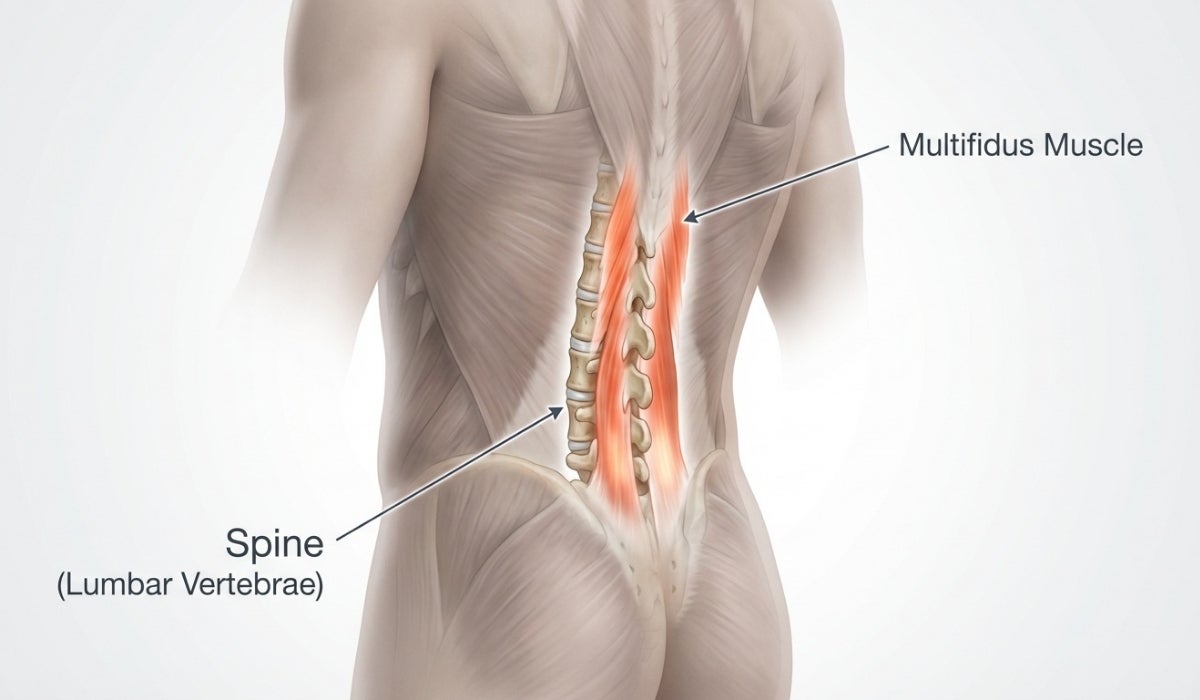
The muscle is called the multifidus.
And it sits 30 to 50 millimeters beneath the skin of your lower back — too deep to be reached by anything you'd find at your local physical therapy clinic.
Why Nothing You Tried Worked

And that explains why everything you've tried has only given you temporary relief — or no relief at all.
Physical therapy — strengthens the surface muscles around the spine. But it does not — and cannot — reactivate the multifidus. The brain has cut the signal. You cannot voluntarily contract a muscle the nervous system has switched off. That's why your therapist could not stabilize your slip with exercises, no matter how disciplined you were.
Cortisone and epidural injections — reduce inflammation around the nerve. But they do nothing to address the structural instability underneath. Each shot lasts shorter than the one before. The body adjusts. The slip keeps grinding.
Painkillers like Gabapentin and Lyrica — mask the pain signal at the brain level. They do absolutely nothing for the muscle that's been shut off, or for the slip that's progressing.
Chiropractic adjustments — temporarily shift the vertebrae back into position. But without the multifidus holding them there, everything snaps back within hours. In some spondylolisthesis cases, adjustments can actually worsen the slip.
TENS units — reach 5 to 8 millimeters deep. The multifidus sits 30 to 50 millimeters down. The pulses never even came close.
Fusion surgery — TLIF, PLIF, or ALIF — locks the slipped vertebra in place with metal hardware. The bone is fixed. The slip is mechanically corrected.
But the procedure itself often makes the multifidus dysfunction worse — the surgeon has to retract this muscle to access the spine, and the nerve branches feeding it get damaged in the process. The bone is fused. The muscle is still gone.
This is why I see so many fusion patients back in my office a year or two later with persistent back pain, instability that won't quit, and adjacent segment disease at the level above or below the fusion.
The slip is fixed. The muscle is still missing.
None of these treatments were designed to do the one thing your spine actually needed.
None of them reactivated the muscle that allowed the slip to happen in the first place.
What Happens When the Multifidus Comes Back Online
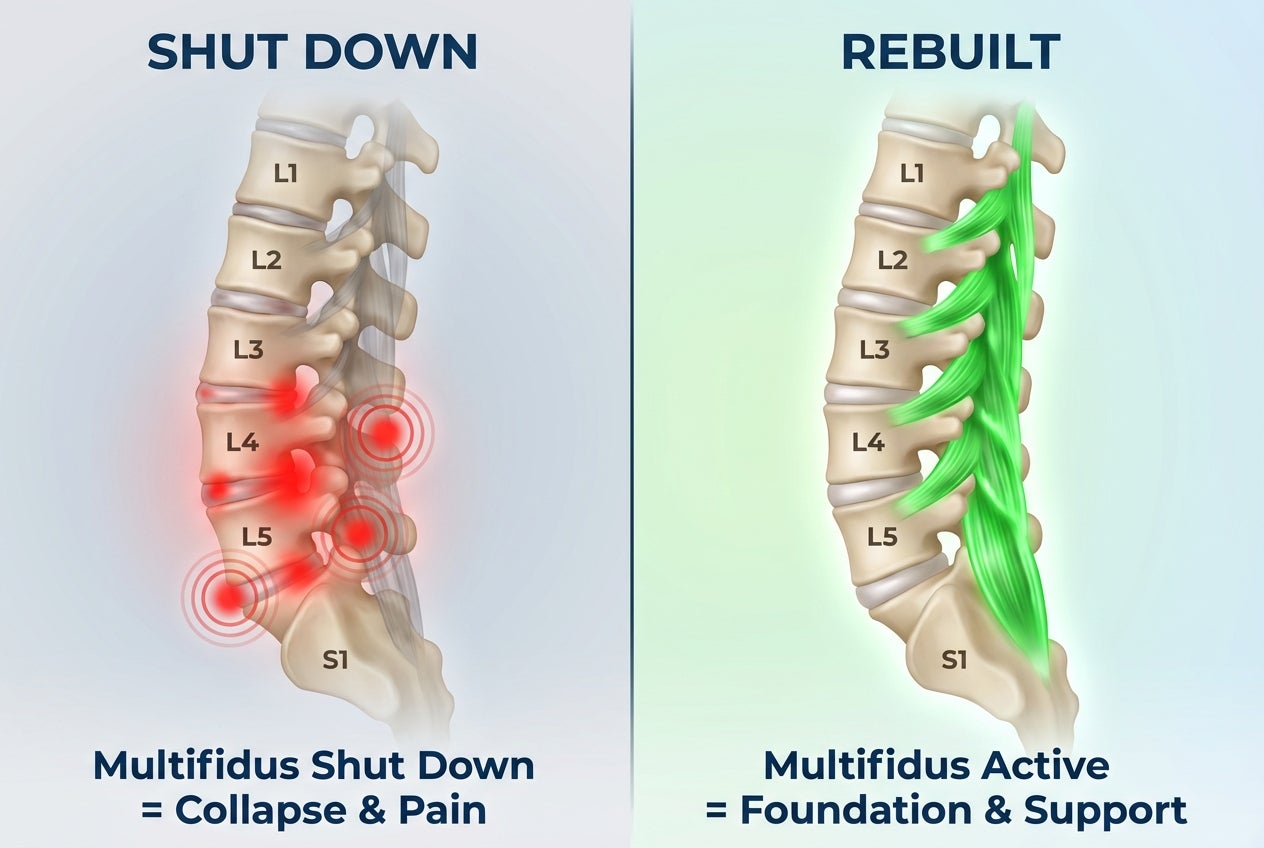
When the multifidus does fire again — something remarkable happens.
Each segment of your spine starts holding itself up the way it was designed to.
The constant sliding sensation calms down. The "going to give out" feeling fades. Pressure lifts off the nerves. The compensation patterns in the surface muscles start to release.
Patients describe it the same way again and again: "I can feel something holding me up from the inside. Something that wasn't there before."
There's a well-documented neuromuscular phenomenon — Core Muscle Lockout — that researchers in spinal rehabilitation have been studying for over a decade.
Their findings are clear: chronic back pain rarely resolves until the multifidus comes back online. And in spondylolisthesis patients where it does come back online, the progression often slows or stops. The vertebra holds its position. Some patients postpone or cancel their planned fusion entirely.
Your body has been capable of holding your spine stable the entire time.
It just never got the one thing it needed to start firing again.
But the window doesn't stay open forever.
The longer the multifidus stays offline, the more it atrophies. Fat replaces the muscle tissue. The spine loses more internal support every month. The slip can progress further. And eventually, the damage becomes much harder to reverse.
How Do You Actually Reactivate the Multifidus?
That was my next question. And the answer isn't what you'd expect.
Think of the multifidus like a light switch that's been flipped off for years.
The wiring is intact. The bulb is fine. The light is just not on.
No amount of exercise will turn it back on. Exercise only works on muscles that can already receive a signal from the brain. The multifidus, in a state of Core Muscle Lockout, cannot.
You cannot stretch it back on.
You cannot strengthen it back on.
You cannot will it back on.
You have to send the signal directly into the muscle itself — bypassing the nervous system block that's keeping it shut down.
And there is only one technology that has been clinically proven to do this.
It's called NMES — Neuromuscular Electrical Stimulation.
NMES is not the same as TENS. The two are often confused. TENS sends weak pulses to the surface of the skin to block pain signals — 5 to 8 millimeters deep. It buzzes. It distracts.
NMES sends targeted electrical signals 30 to 50 millimeters deep — directly into muscle tissue. It forces the muscle to contract. It bypasses the nervous system's "off" signal entirely.
It doesn't ask the multifidus to fire.
It makes it fire.
NMES has been used in elite sports medicine and rehabilitation for over 40 years. It's how Olympic athletes recover from surgery in weeks instead of months. It's how astronauts prevent muscle atrophy during long missions in space.
But for those 40 years, NMES at the depth needed to reach the multifidus was only available inside clinical settings at $300 per session.
That changed recently.
Why I Partnered With ReliveX
When I first started seeing this multifidus research, I went looking for a way to bring this technology to my patients without forcing them into expensive clinic visits.
What I found was a company called ReliveX.
They had developed the first at-home NMES device specifically calibrated to reach the multifidus at the exact depth research had identified — 30 to 50 millimeters.
I spent months evaluating the technology before I was willing to put my name on it.
What convinced me was this: ReliveX is not just a stronger NMES device. It is the only home device that uses what's called Dual-Action Technology — combining decompression and muscle reactivation in a single 15-minute session.
I'll explain what that means — and why it matters specifically for spondylolisthesis.
How the ReliveX Dual-Action System Works
Other devices on the market do one of two things.
They either stimulate the muscle — without addressing the compression that's been crushing the spine.
Or they offer decompression — without addressing the muscle dysfunction underneath.
Neither approach works long-term, because spondylolisthesis is a two-part problem.
Part one: There's mechanical pressure on the nerve. When the vertebra slips forward, the canal narrows. The nerve gets pinched. That pressure needs to come off.
Part two: The multifidus is shut off. Even if you decompress the spine perfectly, without the multifidus firing the moment you stand back up the vertebra has no active stabilizer. The slip is still there. The instability continues.
You need to address both.
At the same time.
In every session.
That's what the ReliveX Dual-Action System does.
Phase A: Decompression. The moment you turn it on, electrical pulses trigger gentle, rhythmic contractions in the deep stabilizing muscles along your spine. Those contractions pull the vertebrae apart from the inside. Pressure lifts off the compressed nerve.
Most patients feel it within the first 2 minutes. A deep opening sensation in the lower back. Like something that has been held tight for years has finally let go. It mimics what a clinical decompression table does — except from the inside out.
Phase B: Re-Education. While Phase A is creating space, Phase B is forcing the multifidus to fire. Contraction after contraction. Over 30 days of consistent use, the neural pathway between brain and muscle rebuilds itself.
The brain remembers how to use the muscle.
The multifidus starts firing on its own again — even when the device is off.
And the segment that has been slipping finally has an active stabilizer holding it from the inside.
Total session time: 15 minutes a day.
That's it.
Here's What Happens During a Session
Here's what happens when you use it.
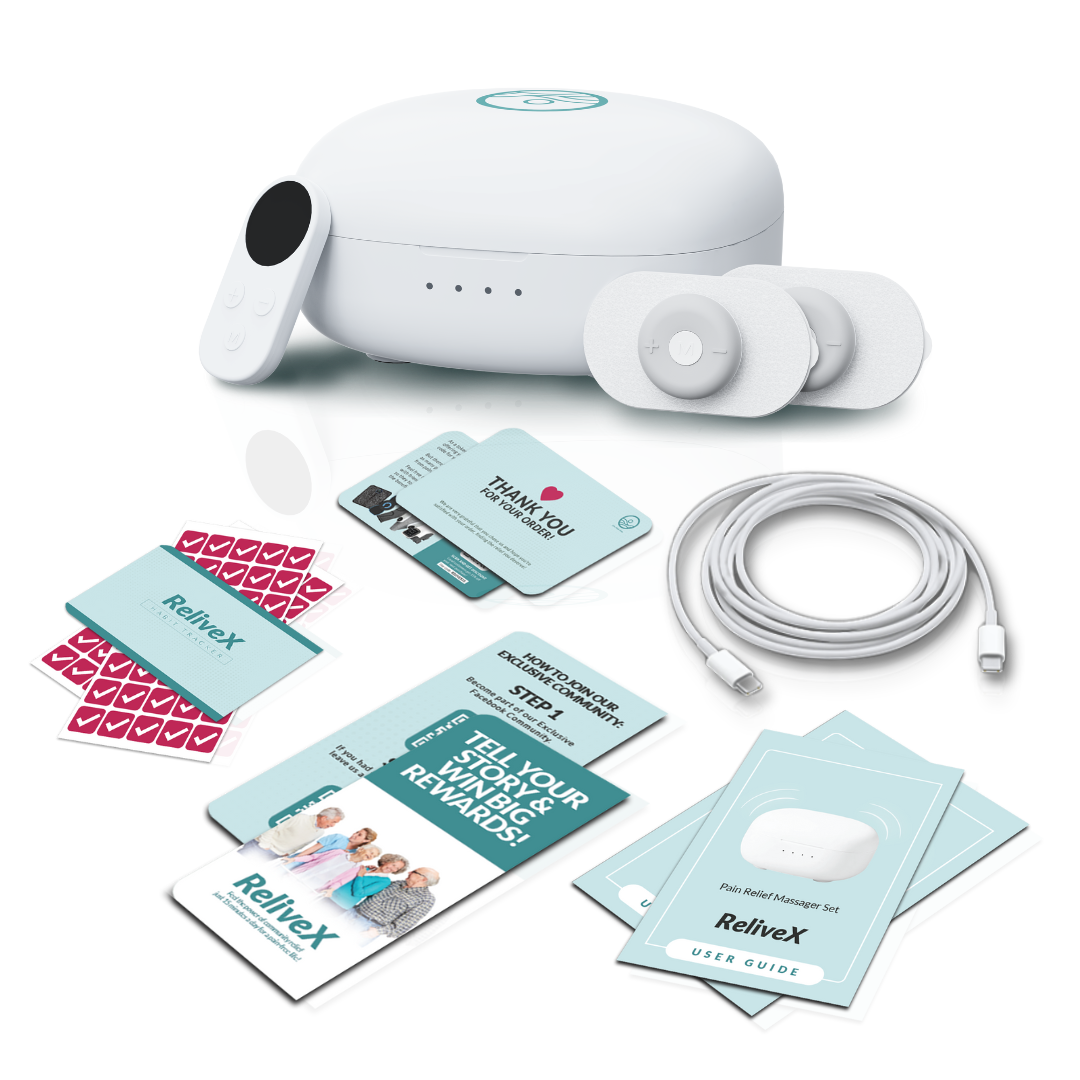
You place the gel pads on either side of your lower spine, exactly where the multifidus sits. You press a button.
The pulse is immediate. And deep. Not the surface buzzing of a TENS unit — something different. A signal reaching into a part of your back that nothing has reached in years.
Then the muscle starts contracting. Not a twitch. A real contraction. Something deep in your lumbar spine engaging in a way that feels both unfamiliar and, underneath that, correct.
You sit very still for 15 minutes.
When the session ends — and the device auto-shuts off, which is by design — most patients describe a sensation they don't quite have words for. "Stable." "Held." "Supported from the inside for the first time."
That's the foundation muscle waking up.
You use it from your couch. While watching TV. While relaxing after work.
No appointments. No copays. No recovery time.
Each session sends the signal to the muscle that's been missing for years.
And with consistent use, most users start feeling significant stability and pain reduction within their first few weeks.
What Real Users Are Saying

At the moment of writing this, over 140,000 patients have used the ReliveX Adaptive Correction System.
Here's what some of them say:

Charlotte Hudson

Cancelled my TLIF
Reviewed in the United States on Januari 27, 2026
Verified Purchase
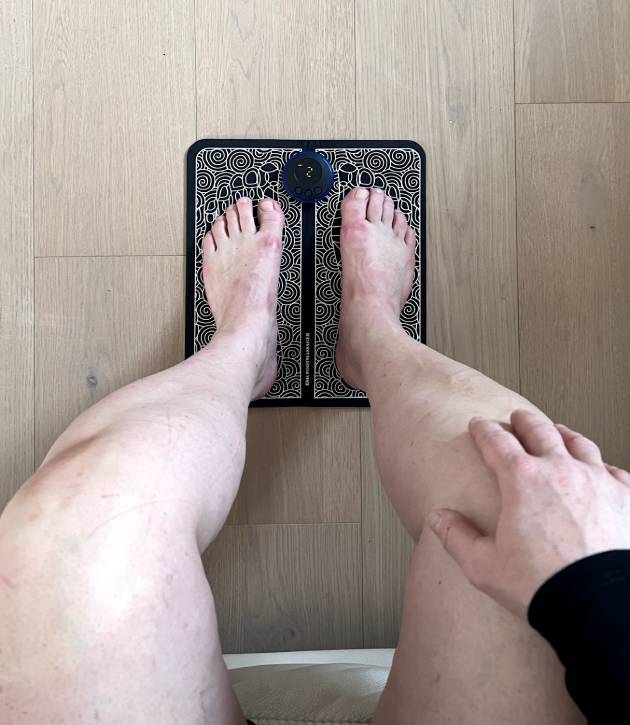
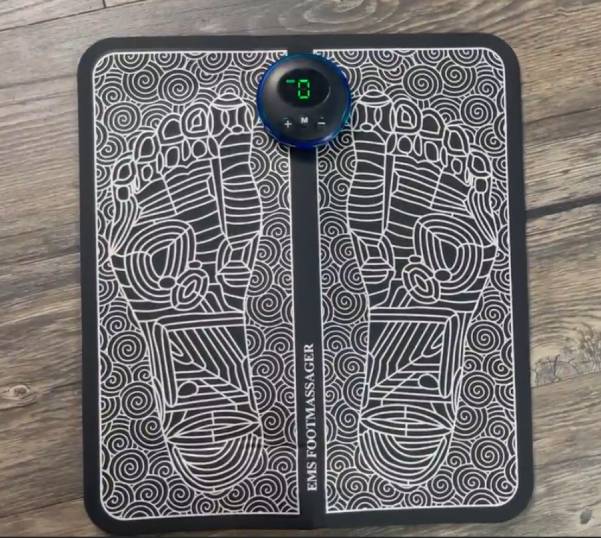
Grade 2 spondylolisthesis at L4-L5 with stenosis on top. TLIF scheduled for April. My back felt like it was going to give out every time I stood up. Eight weeks with ReliveX and I cancelled the surgery. I'm not pain free but the constant shifting feeling is gone. My surgeon was speechless.
76 people found this helpful

William Boxall
The "going to give out" feeling finally stopped
Reviewed in the United States on April 12, 2026
Verified Purchase
Isthmic spondylolisthesis since I was 37. Doc warned me at 39 I'd need fusion by 50. I'm 22 now and refusing surgery. Six weeks with ReliveX and I can stand at the kitchen counter without bracing. First time in over a decade my back doesn't feel like it's about to slip out from under me.
53 people found this helpful

David Barger
Post-fusion regret. This is helping.
Reviewed in the United States on April 21, 2026
Verified Purchase
Had L5-S1 fusion three years ago for spondylolisthesis. Surgeon said it was "perfect." Within 18 months the pain was back. Adjacent segment disease at L4-L5 they told me. Was looking at a second fusion. Twelve weeks with ReliveX and the new pain is fading. I wish I'd known about this BEFORE the first surgery
AS SEEN ON

This Device Has Already Helped Over 140,000 People
And I'm confident it can help you too.
Just imagine…
❌ No more standing up and feeling your spine shift
❌ No more "is this the day my back gives out" worry
❌ No more lying awake at 3 AM trying to find a position that doesn't hurt
❌ No more dreading a fusion that may or may not solve the problem
❌ No more being told to "just live with it" until you're ready for surgery
That's what happens when the muscle that was supposed to hold your spine together finally fires again.
You don't just get relief. You get your spine back.
That's all possible with the ReliveX Adaptive Correction System.
And the best part?
It only takes 15 minutes a day to start feeling a difference.
All you need to do is place the gel pads on either side of your spine, press a button — and let the ReliveX Correction System do the work.
How Can You Get Your Hands on ReliveX?
And what's the price?
The first question is the tricky one.
Because it takes a lot of time and money to build this device.
From the medical-grade components that have to be sourced from around the world… to the extensive testing every unit goes through before it's cleared to ship…
ReliveX is at constant risk of running out of stock.
The ReliveX team is working around the clock to keep up with demand.
But I have to admit they are currently struggling to keep up.
The demand is just too big.
Patients who have tried ReliveX and experienced the relief are now ordering more for their spouses, their parents, their friends.
All of this makes stock run out every time a new shipment comes in.
If you are reading this article, it means there are still a few units left in stock. Otherwise this page would have been taken down.
But I cannot guarantee for how much longer.
ReliveX Is Not Available Anywhere Else Except the Official Website
You will not find it in retail stores. You will not find it on Amazon or eBay.
If you see something similar, that's a cheap knockoff — likely a TENS unit being marketed as something it isn't.
The only place to buy the real, authentic ReliveX Correction System is the official website.
Given how advanced the technology is, and how rapidly patients are experiencing relief, this device is worth every penny.
To put it into perspective, getting clinical NMES treatment at the depth needed to reach the multifidus would cost you $300 per session.
A 12-week course of clinical NMES would run you $7,200.
Add in the physical therapy that didn't work, the injections that wore off, the medications, the consultations — and we're easily into five figures.
And a TLIF fusion? That's between $60,000 and $150,000.
When ReliveX first discussed pricing with me, $1,200 made sense given the clinical-grade technology inside.
But I didn't put my name on this product to sell another expensive medical device that only a few people could afford.
I put my name on it because I wanted every spondylolisthesis patient to have access to the one technology that actually addresses the foundation muscle — before they're forced into surgery.
So ReliveX is priced at just $199.95.
Already 85% cheaper than a single month of pain management.
And less than one third of one percent of what a TLIF will cost you.
If you use it once a day for a year — that comes out to less than 55 cents per session.
55 cents for clinical-grade NMES.
From your couch.
But that's not what you'll pay today.
Get 50% OFF the ReliveX Adaptive Correction System Today
That's just $99.95.
This is the lowest price ReliveX has ever offered.
And I can only guarantee it for today.
So if you are ready to take advantage of the best deal you'll get…
And finally give your spine the one thing it has been missing for years…
Click the button below and grab it while you still can.
You Have 90 Days to Try It, Completely Risk-Free

Yes, you read that right.
ReliveX comes with a 90-day money-back guarantee.
You have 90 full days to use the device and see how well it works for you.
If it works as expected, you are welcome to keep using it every day to continue holding your spine stable.
But if for any reason you are not happy with your purchase…
If you do not feel the muscle waking up. If you do not feel the deep pulse. If you do not feel your spine becoming more stable…
Just let us know anytime in the next 90 days and you'll get your money back. No questions asked.
It doesn't matter if it's 5 minutes or 89 days after the purchase.
ReliveX makes sure that you only pay if you are 100% satisfied with the results.
In any other case, it's on them.
That's a guarantee no surgeon will ever give you.
Fair enough?
That's what I call a risk-free offer.
From the moment you click that button below, your time and your money are protected.
There is zero risk in trying this today.
Here's What To Do Next

Click the button below — it will take you to the official ReliveX website.
Select your package, enter your shipping info, and you're done.
Most people order in under three minutes.
But whatever you do, don't close this page thinking "I'll come back later."
Later doesn't exist when stock is running low.
Remember — There Is Zero Risk
The only risk you could possibly face is the risk of pain, instability, and regret if you miss this opportunity.
Look — I've spent over 35 years treating spondylolisthesis patients. And the ones who did best all had one thing in common.
They stopped waiting and started giving their spine what it actually needed.
That's what this is about.
Not another temporary fix. Not another thing that masks the pain and wears off by dinner. Not another six months of physical therapy that won't touch the muscle that matters. Not necessarily another surgery that may or may not solve the problem.
This is about finally giving the muscle in your lower back the signal it has been missing — so your spine can do what it has always been capable of doing.
Imagine What Your Life Looks Like 30 Days From Now

Standing up from a chair without that sliding sensation in your lower back.
Sitting through a meal without shifting around every few minutes.
Walking the grocery store without scanning for a chair the whole way through.
Sleeping through the night without waking up to a back that feels like it's going to give out.
Standing in your own kitchen without bracing against the counter.
Actually feeling like your spine has something holding it together — because it does.
That's not a fantasy. That's what happens when the multifidus comes back online. And over 140,000 patients are already living it.
You can too.
But that window doesn't stay open forever.
Left alone, the muscle keeps atrophying. The slip can progress. The compensation patterns get more entrenched. The pain pathways become more sensitized.
Some patients end up needing the fusion they spent years trying to avoid.
Some end up needing a second fusion within a decade.
Some end up with permanent nerve damage they cannot reverse.
Some just… stop trying. They accept that this is who they are now.
I'm not saying this to scare you. I'm saying it because I've watched it happen — and it does not have to.

UPDATE: As of - The demand for ReliveX has increased dramatically and inventory has been flying off the shelves. Order your own for 50% OFF + FAST SHIPPING before it's too late.
Lock in your order while you can to get 50% OFF + FAST SHIPPING
NOTE: This deal is NOT available on Amazon or eBay.

90 Day Money Back Guarantee

Guaranteed Safe and Secure Checkout

No-Hassle Returns

Fast Shipping

Customer Reviews

4.8 out of 5
4,991 customer ratings
5 Star

90%
4 Star

7%
3 Star

2%
2 Star

0%
1 Star

1%
By Feature
Price
5.0
Effectiveness
5.0
Comfort
5.0
Quality
4.8
Comments
Add a comment ...

Wilma Devon
Can anybody vouch for this?
Like · Reply ·
4 · 39 min

Mary Vernon
I've been using my ReliveX for a few days now, and I can already feel the deep pulse in my lower back. Super excited to keep going and see more results
Like · Reply ·
7 · 16 min

Doris Skylar
I bought mine for the full price and now are 50% off? That's not fair!
Like · Reply ·
4 · 51 min

Skyler Greig
How long does shipping take??
Like · Reply ·
1 · 1 h

Marie Campbell
Hey Skyler, got mine after 4 days.
Like · Reply ·
2 · 24 min

Leonard Boyd
Grade 1 spondylolisthesis at L5-S1. Had been told to wait until it got worse and they'd do a fusion. Three weeks with ReliveX and the constant shifting feeling is gone. Going back to the surgeon next month with a very different conversation in mind.

Like · Reply ·
6 · 1 h

Emma Emerson
Isthmic spondylolisthesis here. Diagnosed at 15. I'm now 54. ReliveX is the first thing that's helped the instability rather than just the pain.
Like · Reply ·
2 · 2 h

Lois Clive
Wow, this is crazy, have ordered one now!
Like · Reply ·
3 · 1 h

Alfred Johnson
Did you buy one, how long does it take to get it
Like · Reply ·
2 · 2 h

Edith Ashton
For me 4 business days.
Like · Reply ·
5 · 2 h

Debra Peyton
I was waking up at 3AM every single night unable to roll over. Spent thirty minutes every morning just warming up enough to walk to the kitchen. I was embarrassed to tell people how small my world had gotten. The shopping cart thing in this article — that was me, every single grocery trip. Four weeks with ReliveX and I'm sleeping through the night. I get out of bed like a normal person. That alone is worth everything.
Like · Reply ·
1 · 3 h

Paula Remington
Wow looks amazing, does anyone actually have one and has it been tested?
Like · Reply ·
1 · 3 h

Sarah Dudley
Yes, I purchased this device for my mom who's been suffering from spinal stenosis.
Like · Reply ·
3 · 2 h

Agnes Graeme
I just ordered mine! Cannot wait for it.
Like · Reply ·
4 · 3 h

Barbara Bradly
I want one so bad, I'm gonna buy it this weekend when my paycheck hits lol!!
Like · Reply ·
8 · 3 h

Ethel Dean
Does anyone know how long the shipping takes? Want to buy one for my friend.
Like · Reply ·
1 · 4 h

Clara Milton
Hey Ethel, mine arrived after 5 days
Like · Reply ·
2 · 2 h

Emma Shelby
Your friend will be happy! Perfect gift
Like · Reply ·
2 · 1 h

Bridget Prescott
Love this Relivex totally!
Like · Reply ·
3 · 4 h
Clara Milton
I absolutely love my ReliveX, had to get one for my daughter today since she wont stop using mine!
Like · Reply ·
2 · 5 h

Kate Orson
OMG I know, I was so happy that they had some left today. Had to get one immediately before they run out of stock again like last time
Like · Reply ·
5 · 2 h

Isabella Mayson
This product is amazing! For anyone who has ever used an older model TENS device: you end up completely tangled in the wires, and if you need to use it at work to reduce flare-ups, it’s impossible when you have a job that requires a lot of movement. This product frees you from all that and allows you to use it safely. Thanks to whoever created this product.

Like · Reply ·
3 · 5 h
MEDICAL & HEALTH DISCLAIMER: The information and other content provided in this page, or in any linked materials, are not intended and should not be construed as medical advice, nor is the information a substitute for professional medical expertise or treatment.
If you or any other person has a medical concern, you should consult with your health care provider or seek other professional medical treatment. Never disregard professional medical advice or delay in seeking it because of something that have read on this page or in any linked materials. If you think you may have a medical emergency, call your doctor or emergency services immediately.