UPDATE: Nooro Foot Massager is SELLING OUT faster than expected! Lock in your order NOW to get 50% OFF + FAST SHIPPING

At 46, I Was One Step Away From Back Surgery — Then I Learned About The Muscle Nobody Was Checking
After 3 years of a herniated disc, failed physical therapy, injections that stopped working, and being told microdiscectomy was my only option — a project manager from Boston writes the letter she wishes someone had sent her a year ago.

3,791 Ratings

By: Emily Hartman

If you're reading this on the edge of your couch because leaning back sends fire down your leg...
If you're sitting at a desk right now with your right foot half-numb, doing that little dance where you shift your weight every 30 seconds hoping the pain will let up...
If you've got a folder somewhere with your MRI report, your surgeon's business card, and every prescription you've filled in the last 2 years for a pain that keeps coming back no matter what you do...
I'm writing this for you.
Because I was you.
Six months ago, I was scheduled for microdiscectomy.
I had signed the consent forms. Cleared my calendar. Told my boss I'd be out for 6 weeks.
Told my daughter she'd have to skip her spring recital because I couldn't drive her.
I was 46 years old.
My spine surgeon had told me — very kindly, very professionally — that after 3 years of failed conservative treatment, surgery was my only remaining option to get my leg pain under control.
And I believed him.
Because by that point, I'd tried everything.
And nothing had worked.
The 3 Years Before

My sciatica started in January 2023.
I was 43. Project manager for a tech company in Boston. Sitting 9 hours a day in Zoom meetings, running from conference room to conference room in a normal week, occasionally traveling to New York or Chicago.
Then one Tuesday morning I bent down to pick up my laptop bag.
Just bent down.
Something in my lower back went off like a firecracker. Within an hour, my right leg was on fire — a burning line running from my glute down the back of my calf all the way to my heel.
I couldn't put weight on that leg. I couldn't sit. I couldn't stand.
My husband drove me to urgent care. They sent me for an MRI a week later.
"Herniated disc at L5-S1. Significant compression of the S1 nerve root."
I'd never heard those words before.
I learned them fast.
The Parade Of Failures
What followed was 3 years of what I now call the parade.
Everyone with a white coat got their turn.
Physical therapy: 16 weeks. Three times a week. Every single session was planks, bridges, clamshells, dead bugs. "Just strengthen your core," the therapist kept saying. I did the exercises perfectly. My abs got stronger. My glutes got stronger. My leg still burned every time I sat down for more than 15 minutes.
Chiropractor: Twice a week for four months. He was skilled. He'd adjust my lower back and I'd walk out feeling looser. By the time I got to my car, the sciatica was already crawling back down my leg.
Pain management: Two epidural steroid injections. The first one was miraculous. I had 6 weeks of near-complete relief. I thought I'd been saved. The second one gave me maybe 10 days. They wanted to try a third. I said no.
Gabapentin: Made me foggy at work. Made me feel dizzy standing up. My colleague asked me if I was drunk in a meeting. I stopped taking it two months in.
Ibuprofen, Tylenol, muscle relaxants: You know exactly what I mean. They took the edge off just enough to get through the workday. They didn't touch the underlying problem.
A $200 TENS unit my sister ordered from Amazon: I felt a buzzing sensation on my skin. Nothing deeper. I used it every night for a month and put it in the drawer.
Standing desk: Helped for the first week. Then my back started aching from standing too. So I bought a mat. So I bought a chair for when standing hurt. So I sat and stood and sat and stood every 20 minutes like some kind of anxious clock.
Ergonomic office chair ($900): Made zero difference. My glutes still went numb after 20 minutes of sitting no matter how much lumbar support I had.
Yoga, pilates, swimming: Every single one made it worse. I'd have a good session and then be laid up for two days.
By fall 2025, I was scheduled for microdiscectomy.
Surgery was my last option.
My surgeon — a good man, I still believe that — told me it had a "very good chance" of stopping the leg pain.
He also told me the recurrence rate was around 15%. And that I might develop the same problem at another disc within 5 years. And that recovery would be 6-8 weeks with lifting restrictions for 3 months.
I signed the consent forms in October.
Surgery was scheduled for December 8, 2025.
The Morning I Knew Something Was Wrong

It was a Saturday in November.
Three weeks before my scheduled surgery.
I was in the middle of trying to explain to my 12-year-old daughter why I couldn't sit through her band concert without leaving early.
She'd stopped asking me to come to things at that point. She just quietly assumed I wouldn't be there.
She said, without looking at me: "It's okay Mom. I know you can't sit that long."
I went to my bedroom and cried for an hour.
Not from the pain.
From the realization.
My 12-year-old daughter had adjusted her expectations of who her mother was — a woman who couldn't be there for anything that required more than 20 minutes of sitting still.
And in three weeks I was going to have someone cut into my spine and hope for the best.
Something in me needed to know I had actually tried everything.
Not just what the doctors and the physical therapists and the chiropractors had told me to try.
Actually. Everything.
"I didn't know what I was looking for. I just knew that if I was going to let someone remove a piece of my spine, I needed to have exhausted every option that existed."
What Changed
My cousin's husband David is a physical therapist.
He's worked in a sports medicine clinic in Denver for 18 years — mostly with athletes recovering from disc injuries, herniations, and post-microdiscectomy rehab.
I called him on a Sunday afternoon. Told him I was scheduled for surgery in three weeks and asked if there was anything I hadn't tried.
He was quiet for a long moment. Then he asked me a question I'd never been asked before.
"Emily, has anyone, in the last 3 years, ever tested whether your multifidus is firing?"
I didn't know what he meant.
I'd never heard the word.
In three years.
Across five different specialists. Through two MRIs. Through 16 weeks of physical therapy where I did planks and bridges until my abs shook.
Nobody had mentioned the multifidus.
Not once.
David explained it to me on that Sunday afternoon phone call. What I'm about to tell you took him about 25 minutes. I'm going to try to tell it to you the same way.
The One Thing Nobody Told Me
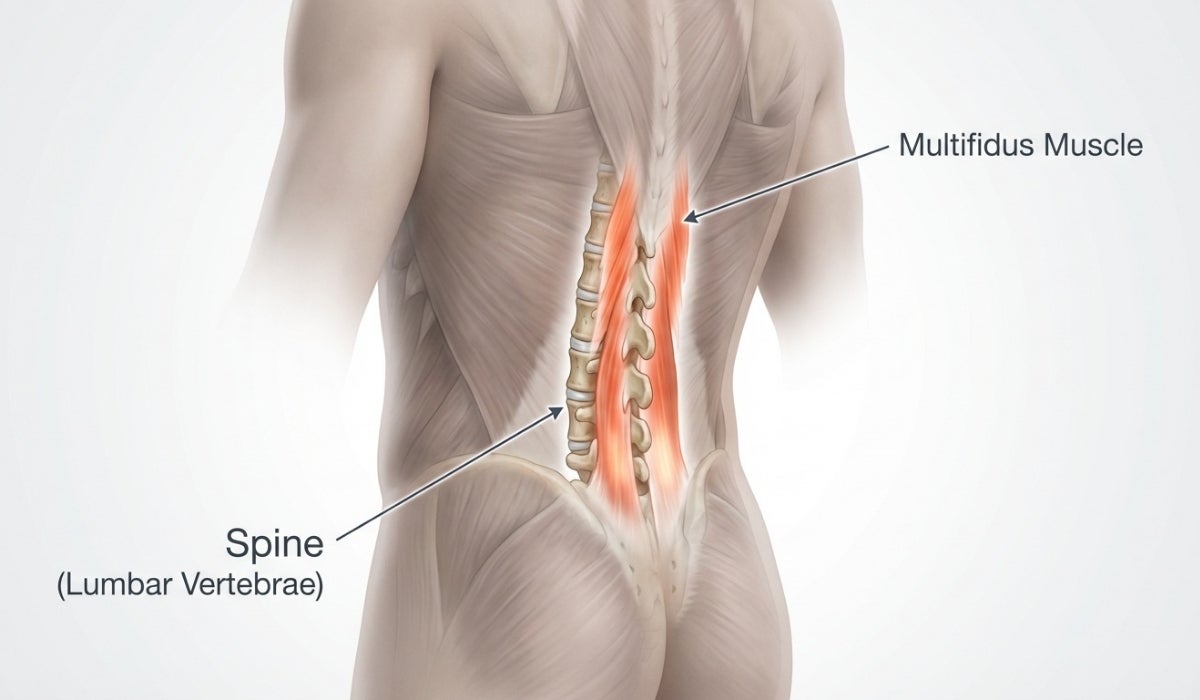
There's a long, deep muscle that runs along both sides of your spine.
It's called the multifidus.
It sits about 3 centimeters beneath the skin of your lower back — right where the L4, L5, and S1 vertebrae meet.
Nobody ever shows you this muscle on a diagram. It's not in the pain clinic pamphlets. Your surgeon doesn't point to it on your MRI.
But it is — without exaggeration — the single most important muscle in your entire lower spine.
Here's why.
Your spine is a stack of bones with discs between them. When those discs are healthy, they absorb pressure and let your spine move freely. When one of them herniates — like mine did at L5-S1 — the gel-like center pushes through the outer layer and presses against your spinal nerves.
That's what causes the burning down your leg. That's what causes the numbness in your foot. That's what causes the shooting pain when you sit.
But the disc itself isn't the whole story.
The multifidus is the muscle that's supposed to protect that disc.
Every time you stand, walk, bend, or turn — this muscle fires thousands of small contractions per minute to stabilize each vertebra and take pressure off the disc between them.
You don't feel it working. You don't think about it. It just works.
Until one day — it doesn't.
Why It Shuts Down
David told me something on that phone call that made me put down my coffee cup.
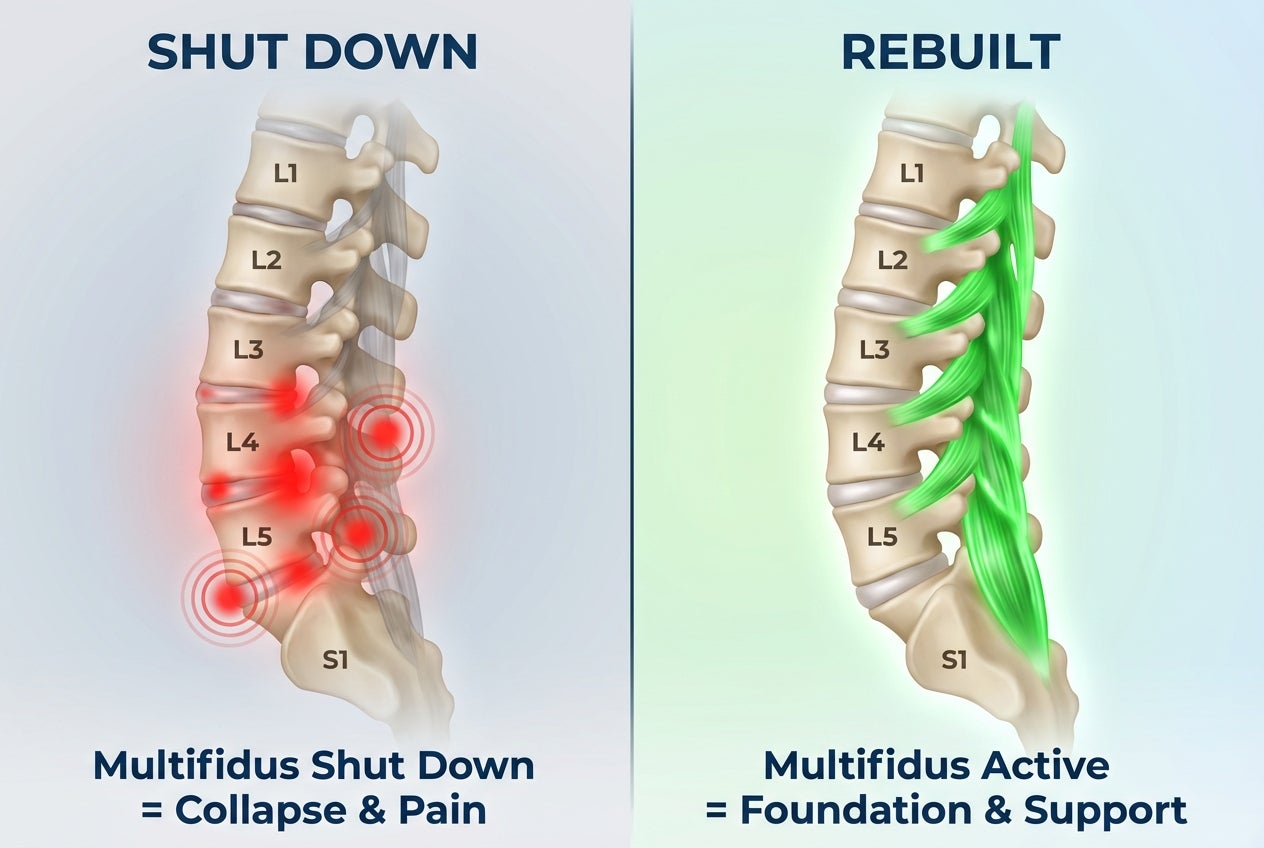
He said: "Emily, when your L5-S1 disc herniated, your brain shut the multifidus off around that segment. On purpose."
Here's what he meant:
When your spine experiences trauma — a disc herniation, stenosis, an injury, even the slow micro-traumas of years sitting at a desk — your brain does something protective.
It cuts the signal to the multifidus around the affected segment.
It tells the muscle: "Stop firing. You're making things worse."
And the muscle obeys.
Within 48 hours of a disc injury, the multifidus can lose up to 80% of its function on the affected side. It goes silent. It atrophies. It shrinks.
And here is the cruel part — the part that had me sitting on my couch with tears in my eyes at 4 PM on a Sunday:
It does not come back on its own.
Not with rest.
Not with stretching.
Not with physical therapy.
Not with the planks, bridges, dead bugs, clamshells, or any of the other "core strengthening" exercises I'd been doing three times a week for 16 weeks.
Because the muscle isn't weak.
It's locked.
You can't strengthen something that isn't firing.
There's a name for this, David told me. Researchers call it Core Muscle Lockout.
And once I heard those two words, everything from the previous 3 years suddenly made sense.
Why Everything Had Failed
Sitting on my couch that Sunday afternoon, I finally understood.
Physical therapy didn't work — because my multifidus was shut off. My therapists were trying to strengthen a muscle that wasn't firing. Every plank I did was training my abs. Every bridge was training my glutes. Not one exercise reached the muscle that had actually gone offline.
The injections only lasted 6 weeks — because they reduced the inflammation around my S1 nerve root temporarily. But nothing was addressing the multifidus underneath. Once the steroid wore off, the same nerve was still being compressed by the same disc bulge — because the muscle that was supposed to stabilize that segment was still offline.
The TENS unit did nothing — because TENS reaches 5-8 millimeters deep. My multifidus sits 30-50 millimeters deep. TENS literally could not reach it.
The chiropractic adjustments didn't hold — because without the multifidus holding my L5-S1 vertebrae in place, everything shifted right back within minutes of leaving his office.
The standing desk, the ergonomic chair, the lumbar cushions — all trying to substitute for a muscle that was supposed to hold me up. Outsourcing the job of the multifidus to external props.
And the microdiscectomy?
David's exact words: "They'll shave off the piece of disc that's pressing on your nerve. That'll take pressure off the S1 root. But it won't do anything for the multifidus. Which is why so many people have the same herniation happen again at an adjacent disc within a few years. Nothing was ever holding the segment stable in the first place."
I wasn't unlucky.
My body hadn't failed me.
I had a muscle that had been turned off for 3 years.
And nobody had ever thought to turn it back on.
What Actually Reactivates It
David told me there was only one thing on earth that could wake up a multifidus that had been locked around a herniated disc.
It wasn't more stretching.
It wasn't harder exercise.
It wasn't surgery.
It was NMES.
Neuromuscular Electrical Stimulation.
Not TENS. He was very clear about this. TENS and NMES are often confused — they're completely different technologies.
TENS blocks pain signals at the surface of the skin. It buzzes. It distracts. It's a pain-masking tool.
NMES sends targeted electrical signals deep into the muscle tissue — forcing the muscle fibers to contract. Bypassing the brain's "off" signal entirely.
It doesn't ask the multifidus to fire.
It makes it fire.
Contraction after contraction. Forcing the muscle back online. Rebuilding the connection between the brain and the muscle that had been severed for years.
NMES has been used for 40 years in elite sports medicine. It's how Olympic athletes recover from disc herniations in weeks instead of months. It's how NASA astronauts prevent muscle atrophy in zero gravity.
It was the one thing that could actually break a Core Muscle Lockout around a herniated disc.
But until recently, you could only access it inside sports medicine clinics at $250 per session.
Then David told me about a device that had been changing that.
The Device That Kept Me Off The Operating Table
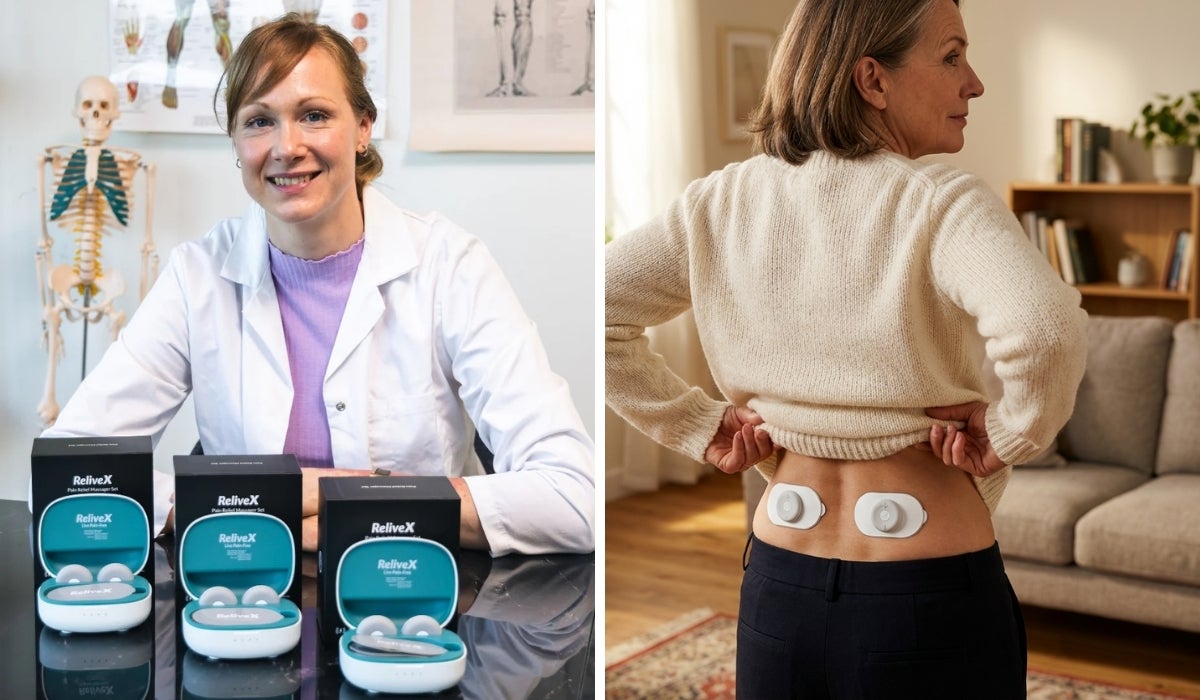
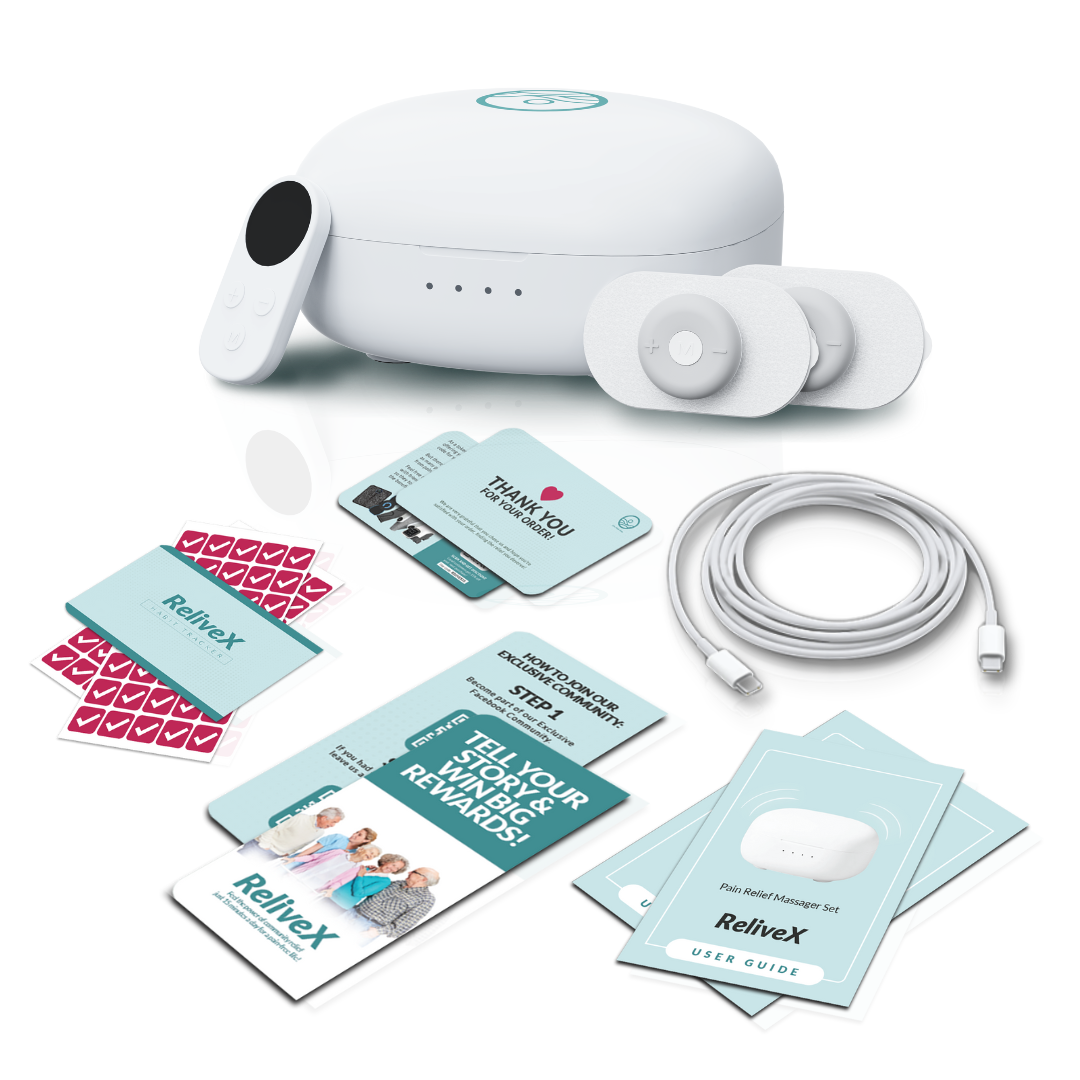
It's called the ReliveX Adaptive Correction System.
It's the first at-home NMES device specifically calibrated to target the multifidus at the exact depth it needs — 30 to 50 millimeters — to break a Core Muscle Lockout around a herniated disc.
But here's what makes it different from every other NMES device on the market.
It doesn't just stimulate the muscle.
It decompresses the segment AND rebuilds the muscle — at the same time.
David explained the two phases to me:
Phase A: Decompression. The electrical pulses trigger gentle, rhythmic contractions that pull the vertebrae apart around the herniated segment. Creating space. Lifting the pressure off the disc. Lifting the pressure off the nerve. It mimics what a clinical decompression table does — except from the inside out.
Phase B: Re-Education. While Phase A is creating space, Phase B is forcing the multifidus to fire around the affected segment. Contraction after contraction. Over 30 days, the neural pathway between brain and muscle rebuilds itself. The brain "remembers" how to use the multifidus. The muscle starts firing on its own again — stabilizing the exact segment where your disc herniated.
15 minutes a day.
That was the whole protocol.
I'd spent — let me see.
Between the surgery consult, the 16 weeks of PT, the chiropractor, the injections, the medications, the standing desk, the ergonomic chair, the TENS unit — I had spent over $18,000 trying to fix my back in 3 years.
And here was this small device that David was texting me the link to.
$99.95.

Charlotte Hudson

I did 8 months of PT — all of it was training the wrong muscle
Reviewed in the United States on Januari 27, 2026
Verified Purchase
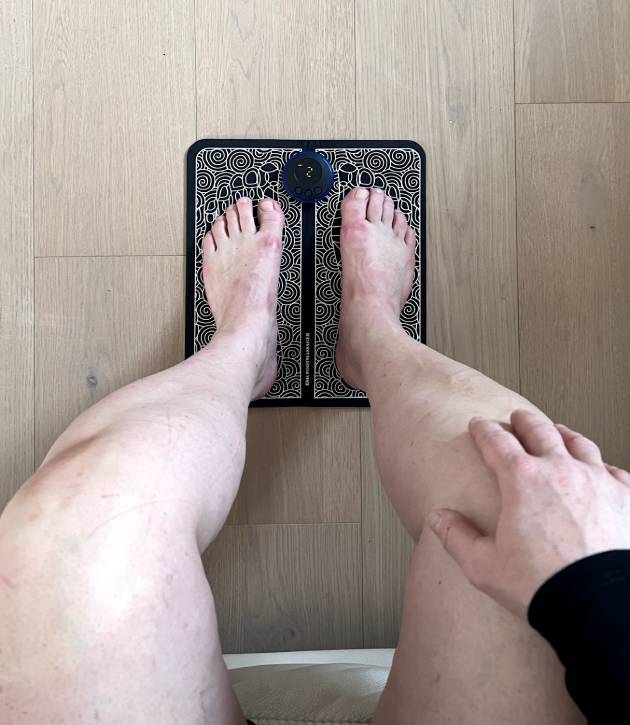
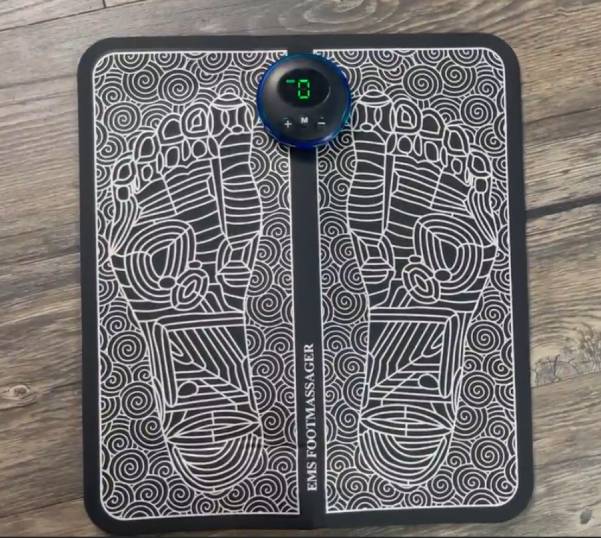
L5-S1 herniation for 2 years, scheduled for microdiscectomy last November. Cancelled it the day after ordering ReliveX. 11 weeks in — calf burning gone, sat through a 3-hour road trip last week without shifting once. First time in 18 months.
76 people found this helpful

William Boxall
The one-toe test is real — and now I can do it again
Reviewed in the United States on April 12, 2026
Verified Purchase
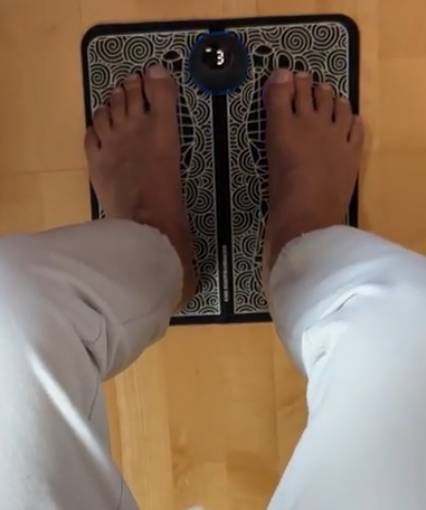
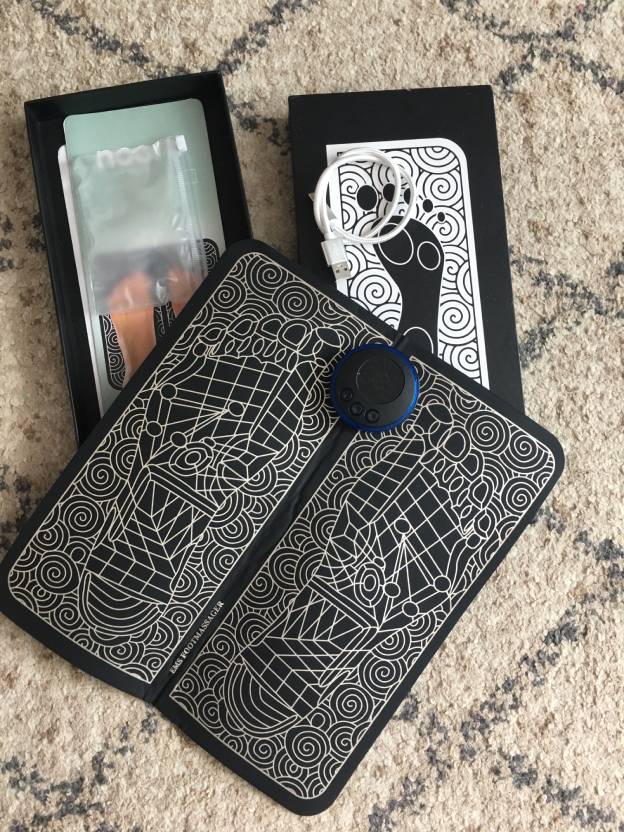
Sales rep, drove 4 hours a day with sciatica for 2 years. Couldn't push up on my right toe at the gym six months ago. Two epidurals stopped working. Week 5 with ReliveX, I did a full toe raise in my kitchen. Started running again week 10.
53 people found this helpful

Jennifer M.
Sat through half a movie for the first time in 3 years
Reviewed in the United States on April 21, 2026
Verified Purchase
L5-S1 herniated during my second pregnancy. Couldn't make it through appetizer at our anniversary dinner last November. Read Emily's letter, ordered that night. Week 6: full movie with my husband. Week 9: concert standing and sitting. Whatever the crowd did.
AS SEEN ON

The First 30 Days
My husband ordered it that Sunday night.
It arrived seven days later.
I'll be honest — I opened the box with almost no hope. I'd been burned so many times. I'd had so many "miracle solutions" turn into drawer ornaments that I couldn't emotionally handle another failure.
I told my husband: "If this doesn't work, I'm going through with the surgery in two weeks."
I meant it.
Day 1: I placed the pads on either side of my lower spine, right around L5-S1. I started at a low intensity. And I felt something I had not felt in 3 years.
A deep pulse.
Not on the surface.
Inside.
It was strange. Almost uncomfortable at first — because I was feeling a muscle that I had essentially forgotten existed. But by minute 8, my lower back felt... open. I don't know another word for it. Like something around L5-S1 had let go.
I stood up after the session. Walked to the kitchen. And for a moment — one full minute — I forgot about my leg.
I hadn't done that in 3 years.
Week 1: Mornings got easier. The 15-minute limp I'd been doing every morning to get from bedroom to bathroom shrank to 5 minutes. I sat through a 45-minute work meeting without doing my usual shifting dance.
Weeks 2-3: I started noticing I wasn't pre-planning where I would sit in meetings anymore. I'd just been... walking in. Sitting down. Being present. My colleagues noticed. My boss asked what had changed. I didn't know how to explain it yet.
Week 4: I sat through my daughter's band concert. All of it. All 90 minutes. I stood up at the end to clap and my leg was there, holding me up, no burning, no numbness.
She saw me clapping and her face lit up in a way I hadn't seen since she was 8 years old.
I cried in the school parking lot afterward.
"I called the surgery scheduler the next morning. I told her I needed to postpone. She asked if I wanted to reschedule. I said no. I'd let her know."
Where I Am Now
I'm writing this 7 months after that first session.
Last month I flew to Chicago for a client meeting. Three-hour flight. First class was booked so I flew coach — middle seat. Two years ago that would have been a nightmare. I got off the plane and walked to baggage claim without limping.
I never went back to the surgeon.
I use the ReliveX Adaptive Correction System for 15 minutes on Monday, Wednesday, and Friday now.
That's my maintenance routine.
The rest of the time, my multifidus holds my L5-S1 segment stable.
Like it's supposed to.
Like it did before that Tuesday morning in January 2023.
What I Want You To Know

If you're sitting where I was — on the edge of your couch, on the edge of scheduling surgery, on the edge of believing this is just your life now —
I'm writing this because I wish someone had sent me this letter in 2023. Or 2024. Or even three weeks before my scheduled microdiscectomy.
You haven't failed.
Your body hasn't failed you.
There is a muscle in your back — right around the segment where your disc has herniated — that has been turned off, maybe for years, and no one has ever tried to turn it back on.
You are not broken.
You are locked.
And there is a difference.
ReliveX Adaptive Correction System
The at-home NMES device I use every day.
Uses NMES (not TENS) — reaches 30-50mm deep to the multifidus
Dual-Action — Phase A Decompression + Phase B Re-Education
15-minute auto-shutoff — the exact window for reactivation
Wireless, portable, easy to use
FDA-cleared and CE-certified
Designed for L5-S1 disc pathology and sciatica recovery
Trusted by 140,000+ patients with chronic back pain
90-Day Money-Back Guarantee
50% off today — limited stock
Today it's available at 50% off — $99.95.
Less than ONE physical therapy session. Less than ONE month of Gabapentin. Less than the ergonomic chair I bought that didn't help.
The 90-Day Guarantee

Use it for 90 days. 15 minutes a day.
If you're not feeling the same thing I felt — the deep pulse, the opening around your L5-S1 segment, the muscle coming back online — send it back.
Full refund. No forms. No "store credit." Just email and they'll take care of it.
You have 90 days to know if this is the thing that finally works.
That's more than enough time.
I knew by day 18.
One Last Thing
If this letter has reached you, I'd ask you one favor.
Don't put it off.
I spent 3 years waiting for someone to tell me about my multifidus. I spent nearly $20,000 on things that didn't work. I missed my daughter's concerts. I sat in my bedroom crying while she quietly stopped inviting me to things.
Every day you wait is another day your muscle stays locked around your herniated disc.
Another day of compensation patterns building up in your hips, your knees, your shoulders.
Another day closer to the surgery your surgeon is already preparing to schedule.
If David had told me about this six months earlier, I would have had six more months of a life I
recognized.
You have today.
That's enough.
With hope,
Emily Hartman

UPDATE: As of - The demand for ReliveX has increased dramatically and inventory has been flying off the shelves. Order your own for 50% OFF + FAST SHIPPING before it's too late.
Lock in your order while you can to get 50% OFF + FAST SHIPPING
NOTE: This deal is NOT available on Amazon or eBay.

90 Day Money Back Guarantee

Guaranteed Safe and Secure Checkout

No-Hassle Returns

Fast Shipping

Customer Reviews

4.8 out of 5
3,791 customer ratings
5 Star

90%
4 Star

7%
3 Star

2%
2 Star

0%
1 Star

1%
By Feature
Price
5.0
Effectiveness
5.0
Comfort
5.0
Quality
4.8
Comments
Add a comment ...

Wilma Devon
Can anybody vouch for this?
Like · Reply ·
4 · 39 min

Mary Vernon
This little thing is fantastic. My lower back aches constantly. After a long day, 15 minutes with this and the pain is gone. I've got stenosis and a herniated disc on top of that — nothing has helped like this does. Genuinely surprised how powerful it is.
Like · Reply ·
7 · 16 min

Doris Skylar
I bought mine for the full price and now are 50% off? That's not fair!
Like · Reply ·
4 · 51 min

Skyler Greig
How long does shipping take??
Like · Reply ·
1 · 1 h

Marie Campbell
Hey Skyler, got mine after 4 days.
Like · Reply ·
2 · 24 min

Leonard Boyd
L5-S1 herniation for 2 years. Surgeon told me microdiscectomy was inevitable. 8 weeks with ReliveX and I sat through a 4-hour flight to Denver without moving. My surgeon has no idea what I've been doing.

Like · Reply ·
6 · 1 h

Emma Emerson
Herniated disc at 39. Did every plank, bridge, and dead bug in existence for 6 months. Nothing helped. Emily's line about "training abs instead of the multifidus" hit me hard. 5 weeks in and the calf pain is finally fading. I can sit through a movie again.
Like · Reply ·
2 · 2 h

Lois Clive
Wow, this is crazy, have ordered one now!
Like · Reply ·
3 · 1 h

Alfred Johnson
Did you buy one, how long does it take to get it
Like · Reply ·
2 · 2 h

Edith Ashton
For me 4 business days.
Like · Reply ·
5 · 2 h

Debra Peyton
I was waking up at 3AM every single night unable to roll over. Spent thirty minutes every morning just warming up enough to walk to the kitchen. I was embarrassed to tell people how small my world had gotten. The shopping cart thing in this article — that was me, every single grocery trip. Four weeks with ReliveX and I'm sleeping through the night. I get out of bed like a normal person. That alone is worth everything.
Like · Reply ·
1 · 3 h

Paula Remington
Wow looks amazing, does anyone actually have one and has it been tested?
Like · Reply ·
1 · 3 h

Sarah Dudley
Yes, I purchased this device for my mom who's been suffering from spinal stenosis.
Like · Reply ·
3 · 2 h

Agnes Graeme
I just ordered mine! Cannot wait for it.
Like · Reply ·
4 · 3 h

Barbara Bradly
I want one so bad, I'm gonna buy it this weekend when my paycheck hits lol!!
Like · Reply ·
8 · 3 h

Ethel Dean
Does anyone know how long the shipping takes? Want to buy one for my friend.
Like · Reply ·
1 · 4 h

Clara Milton
Hey Ethel, mine arrived after 5 days
Like · Reply ·
2 · 2 h

Emma Shelby
Your friend will be happy! Perfect gift
Like · Reply ·
2 · 1 h

Bridget Prescott
Love this Relivex totally!
Like · Reply ·
3 · 4 h
Clara Milton
I absolutely love my ReliveX, had to get one for my daughter today since she wont stop using mine!
Like · Reply ·
2 · 5 h

Kate Orson
OMG I know, I was so happy that they had some left today. Had to get one immediately before they run out of stock again like last time
Like · Reply ·
5 · 2 h

Isabella Mayson
This product is amazing! For anyone who has ever used an older model TENS device: you end up completely tangled in the wires, and if you need to use it at work to reduce flare-ups, it’s impossible when you have a job that requires a lot of movement. This product frees you from all that and allows you to use it safely. Thanks to whoever created this product.

Like · Reply ·
3 · 5 h
MEDICAL & HEALTH DISCLAIMER: The information and other content provided in this page, or in any linked materials, are not intended and should not be construed as medical advice, nor is the information a substitute for professional medical expertise or treatment.
If you or any other person has a medical concern, you should consult with your health care provider or seek other professional medical treatment. Never disregard professional medical advice or delay in seeking it because of something that have read on this page or in any linked materials. If you think you may have a medical emergency, call your doctor or emergency services immediately.